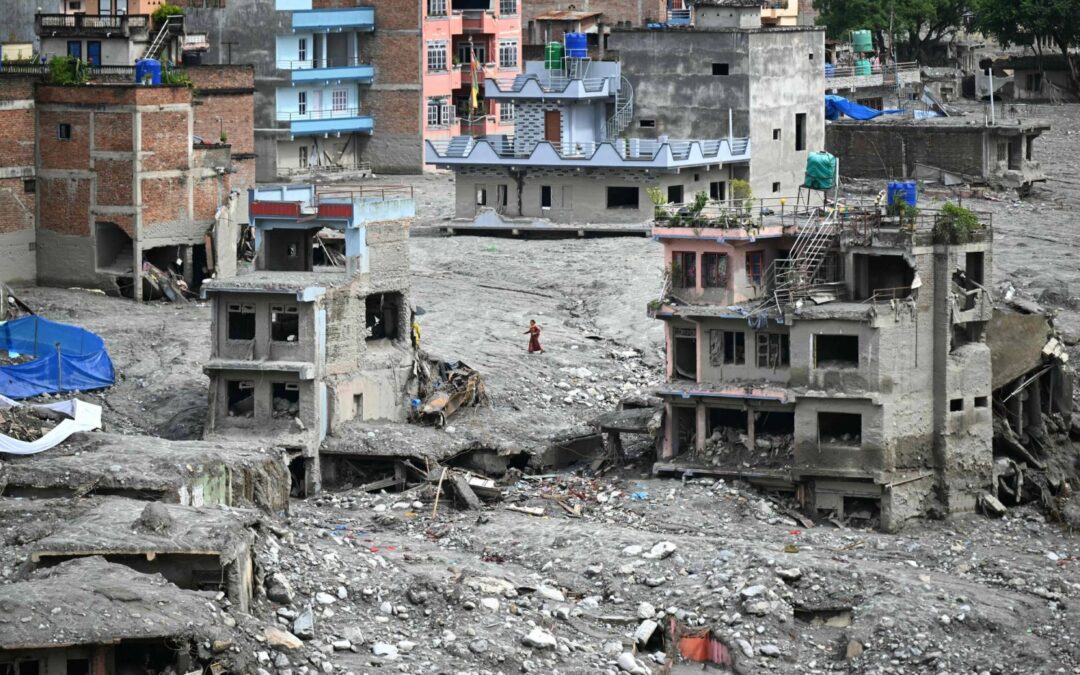
The first scientific assessment of the deadly August 26 Nepal-Tibet disaster has found that human-caused climate change likely contributed to destabilising the rock-and-ice slope whose collapse set off the catastrophe. Researchers linked decades of global warming to thinning glaciers, thawing permafrost, and a shift from snowfall to rainfall in the region.
Friederike Otto, a climatologist at Imperial College London and co-author of the World Weather Attribution (WWA) study, said there was no question that human-driven climate change had helped set the stage for the disaster, pointing to permafrost thaw, glacier thinning, and increased rainfall replacing snow as contributing factors.
A cascading disaster, not a typical flood
Researchers characterised the event as a chain reaction rather than a standard flood. Roughly 2 square kilometres of rock wall and glacier ice broke away from Langtang Lirung at an elevation of about 5,150 metres, falling approximately 1,400 metres before transforming into a debris flow. The resulting mass of water, rock, ice, and sediment covered around 22km to reach Rasuwagadhi in just seven minutes, giving communities downstream virtually no time to react.
Climate factors behind the collapse
The study found that sustained warming had raised freezing levels over time, exposing rock and permafrost that had previously remained frozen to extended thawing — weakening the material that holds steep slopes together. July and August were unusually hot, with researchers calculating that human-caused warming added roughly 1.5°C to regional temperatures. Heavy snowfall in late 2025 may have contributed further meltwater. Researchers also noted that Nepal’s magnitude-7.8 earthquake in 2015 could have weakened mountain slopes over time, though its precise contribution couldn’t be measured.
Independent climate adaptation researcher Priyanka Vadrevu said that rising temperatures are thinning ice, thawing permafrost and weakening the frozen material that helps hold steep slopes together, and argued that Himalayan disaster preparedness needs to move beyond rainfall and conventional flood forecasting toward integrated monitoring covering glaciers, permafrost, slopes, rivers, and weather patterns.
Implications for climate financing and diplomacy
Nepal is now expected to pursue approximately $20 million (£15 million) in support from the UN Fund for Responding to Loss and Damage, which assists countries dealing with climate-related devastation. The new study is likely to bolster Kathmandu’s case by establishing a scientific link between warming and the conditions that led to the slope failure.
The findings are also expected to feature in Nepal’s diplomatic efforts next week. Prime Minister Balendra Shah is set to travel to New York from September 22–26 for the UN General Assembly — his first international trip since taking office — where the government says he plans to draw attention to the August 26 disaster, Nepal’s vulnerability as a Himalayan nation, and calls for greater climate justice and financing for countries facing outsized losses from global warming.