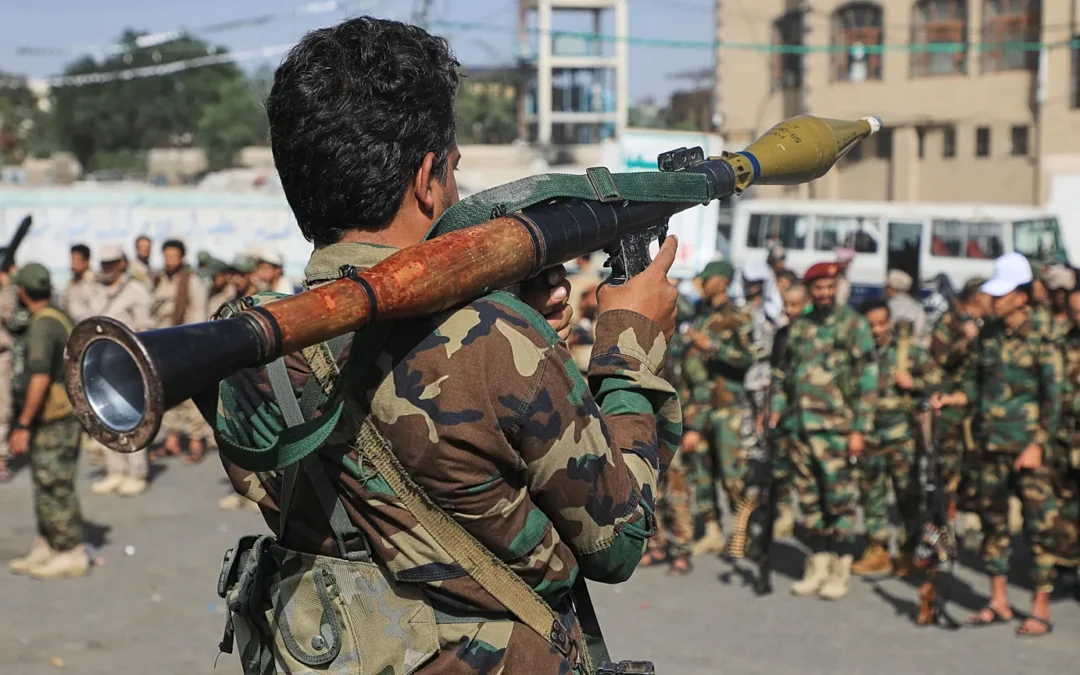
Iranian-supplied weapons, drones and alleged direct guidance from commanders of the Islamic Revolutionary Guard Corps (IRGC) helped the Iran-backed Houthis seize Yemen’s strategic Red Sea port city of Mocha in a rapid offensive, according to Reuters.
The lightning advance along Yemen’s western coast has strengthened the Houthis’ hold over a strategically vital stretch of the Red Sea, close to the Bab el-Mandeb Strait. The narrow waterway connects the Red Sea with the Gulf of Aden and serves as a crucial artery for international shipping, giving the Houthi advance potentially far-reaching implications for global trade and energy supplies.
Reuters, citing Yemeni government, Iranian and regional sources, reported that Tehran instructed the Houthis last week to step up attacks against Saudi Arabia and pledged additional funding, weapons and senior military personnel to support the campaign.
A regional diplomat briefed by Tehran said several senior IRGC commanders had travelled to Yemen to help oversee and direct Houthi operations targeting Saudi Arabia.
Iranian Weapons Power the Houthi Blitz
Five Saudi-backed Yemeni military sources told Reuters that the latest Houthi offensive across the Tihama coastal plain began with an intense barrage of rockets and was directed with the involvement of IRGC personnel.
The sources, citing intercepted communications and accounts from captured Houthi fighters, said they believed the operation was being overseen by Abdolreza Shahlaei, a senior IRGC commander associated with the Qods Force.
Iranian sources did not confirm Shahlaei’s reported involvement. They acknowledged, however, that IRGC personnel had previously operated in Yemen and said the force continued to move weapons and personnel into and out of Houthi-controlled territory despite an aerial and maritime blockade.
The Houthis’ growing weapons arsenal appears to have been central to the speed of their latest advance. Ahmed Nagi, a Yemen analyst at the International Crisis Group, told Reuters that the group’s military capabilities have evolved rapidly through weapons acquired either directly from Iran or via smuggling networks, with drones playing a particularly important role in the latest offensive.
Iran has consistently denied directing the Houthis, describing the group as an ally rather than a proxy. An Iranian official cited by Reuters said the assault on Mocha was a Houthi decision, although it also served Tehran’s strategic interests by potentially putting upward pressure on oil prices and increasing pressure on Washington and Riyadh.
Why Mocha Matters
Located roughly 80 kilometres from the Bab el-Mandeb Strait, Mocha sits close to one of the world’s most important maritime chokepoints. Control of the port could give the Houthis a stronger strategic position from which to threaten shipping along the Red Sea.
Commercial traffic through the Bab el-Mandeb has already been severely disrupted by Houthi attacks. Shipping through the waterway has fallen sharply since the group began targeting vessels in late 2023, prompting many operators to take the longer route around Africa.
The strategic stakes have risen further amid the wider confrontation involving Iran, the United States and Israel, which has also disrupted shipping through the nearby Strait of Hormuz.
Saudi Arabia had sought to reduce its dependence on the Strait of Hormuz by transporting oil through pipelines to the Red Sea port of Yanbu. However, renewed Houthi threats have curtailed that activity, according to Lloyd’s List Intelligence.
The capture of Mocha also marks the Houthis’ most significant territorial gain since the 2022 truce brought a period of relative calm following years of civil war.
The dramatic advance has raised fears that Yemen could once again descend into a broader conflict. Such a development could have consequences far beyond the country’s borders, potentially affecting Saudi Arabia’s security, Red Sea shipping and already-sensitive global energy markets.
With the Houthis now holding a strategically important position near one of the world’s busiest maritime chokepoints, the latest offensive could add a dangerous new dimension to tensions across the Middle East.