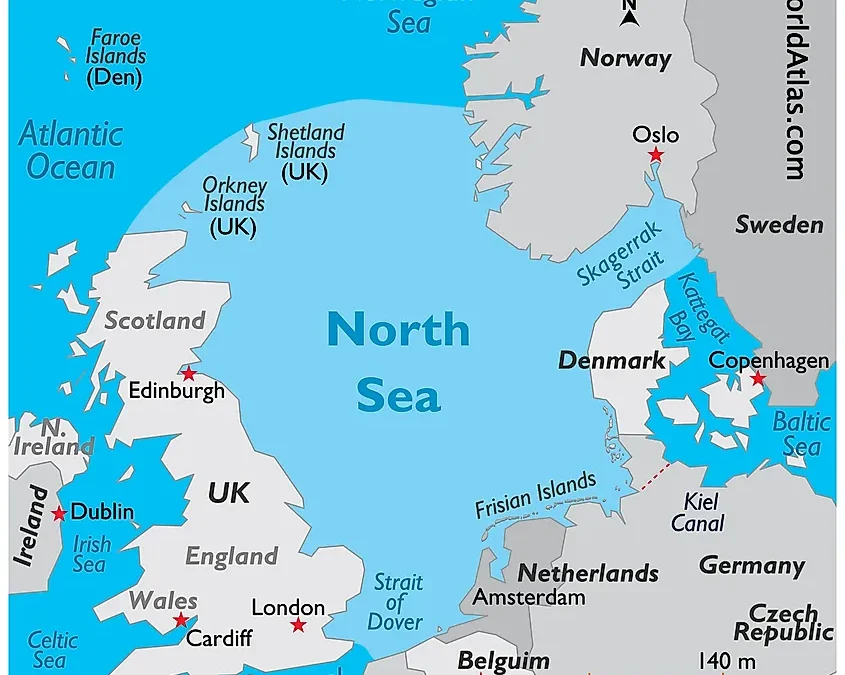
Forty-five kilometres off the Belgian coast, a remarkable engineering project is taking shape in the middle of the North Sea. Belgium is building the world’s first artificial energy island — an offshore power hub spanning an area roughly equivalent to eight football fields.
Known as Princess Elisabeth Island, the project is being constructed using 23 enormous concrete caissons, each weighing around 22,000 tonnes. Rather than accommodating homes or becoming a wildlife sanctuary, the artificial island is designed to serve as a major electricity hub, collecting power generated by future Belgian offshore wind farms and transmitting it to the mainland through submarine cables.
The project is being developed by Belgian electricity transmission system operator Elia and constructed by the TM Edison consortium, comprising Belgian engineering companies DEME and Jan De Nul.
A major milestone was reached in January 2026, when the final caisson was completed and launched, bringing the manufacturing phase to an end. The giant structures are now undergoing final preparations before being installed at sea.
Building an island from 22,000-tonne blocks
Each caisson measures approximately 58 metres in length, 28 metres in width and between 23 and 32 metres in height, depending on the configuration of its storm walls.
The blocks were manufactured at the port of Vlissingen in the Netherlands on a five-station production line, allowing several units to be constructed simultaneously. Building a single caisson takes around 85 days.
Once completed, the caissons are towed partially submerged to the construction site. A foundation bed is prepared in advance using dredging equipment and specialised vessels. The caissons are then positioned over the foundation and filled with sand, allowing them to settle securely onto the seabed.
The first installation campaign began in April 2025 with two caissons and continued until October. Work is scheduled to resume in spring 2026, subject to weather conditions. The entire installation programme is expected to take around two years, with operations suspended during the winter storm season. Moving, positioning and securing each caisson takes approximately 24 hours.
An offshore electricity superhub
Princess Elisabeth Island is not intended to function as an island in the traditional sense. Instead, it will act as a giant offshore electricity distribution hub.
Its infrastructure will combine high-voltage alternating current (HVAC) and high-voltage direct current (HVDC) systems — an unusual combination at sea and a key reason the project is being described as the world’s first “energy island”.
The facility will consolidate submarine cables carrying electricity from offshore wind farms planned for the Princess Elisabeth Zone, a 285-square-kilometre area expected to generate up to 3.5 gigawatts of offshore wind power.
The island is also designed to connect Belgium with future international electricity interconnectors. These include Nautilus, linking Belgium with the United Kingdom, and TritonLink, which will connect it with Denmark. Such links could allow electricity to be exchanged between national grids depending on demand and renewable power availability.
Concrete meets nature
Despite its massive concrete structures, the project is being designed with marine biodiversity in mind. Elia and its partners have worked with conservation experts under a “nature-inclusive design” approach aimed at integrating habitats into the island’s infrastructure.
The outer walls will feature specially designed structures providing nesting and roosting spaces for kittiwakes, a seabird considered threatened in the North Sea. Submerged structures will also create habitats for marine organisms, while dedicated features are being incorporated for the European flat oyster.
The EU-backed NID4BirdLIFE programme will monitor the development of bird nests for six and a half years using cameras installed within the island’s walls.
Costs soar to €7 billion
The scale of the project is reflected in its rising cost. In October 2024, the European Investment Bank approved €650 million in financing for Elia Transmission Belgium’s first phase, which at the time had an estimated total cost of €1.105 billion.
However, the project’s projected cost has since increased dramatically, reportedly rising from an initial estimate of around €650 million to as much as €7 billion. The surge has largely been attributed to higher costs for electrical equipment and has raised questions about the project’s financial viability.
The main civil engineering work is expected to be completed by mid-2026, while installation of the electrical infrastructure is scheduled to continue from 2026 through 2030.
Princess Elisabeth Island is expected to become operational around 2030, alongside the new offshore wind farms and major Belgian grid projects such as Ventilus and Boucle du Hainaut, which will help deliver the renewable electricity to consumers.