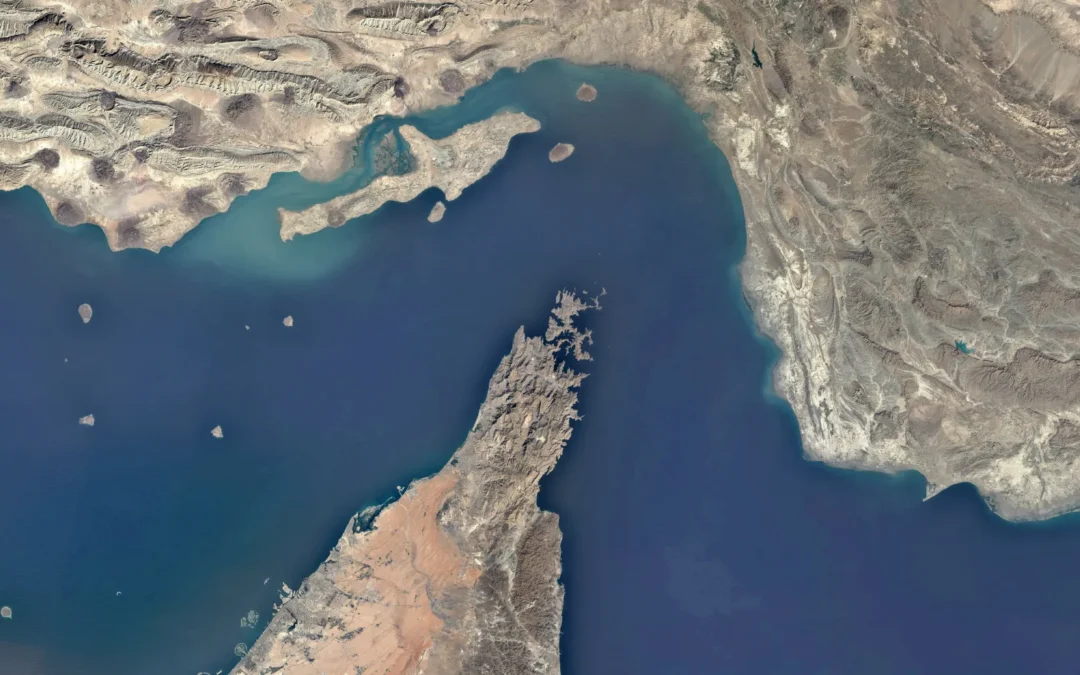
US forces struck two Iranian rocket launchers on Larak Island in the Strait of Hormuz on Sunday, marking Washington’s first publicly confirmed military action against Iran since late July and ending weeks of relative calm in the conflict.
The United States said the strike was carried out after Iranian Revolutionary Guard Corps (IRGC) forces were observed preparing to launch rockets carrying sea mines into the strategic waterway. US Central Command described the operation as a limited and precise action aimed at preventing an imminent threat to civilian shipping and protecting freedom of navigation through the Strait of Hormuz.
Iran swiftly condemned the attack and warned that Washington would face retaliation. The IRGC said several Iranian military personnel and civilians were killed or wounded, although it did not provide an exact casualty figure. Iranian state and semi-official media reported explosions on Larak Island.
Iran subsequently launched ballistic missiles at US military bases in Jordan, according to Iranian and US officials. Jordan’s armed forces said its air-defence systems intercepted eight missiles that entered the country’s airspace. The missiles were destroyed before causing casualties or property damage, according to Jordanian authorities.
Iran’s IRGC said the retaliatory operation targeted the King Hussein and Al Azraq bases in Jordan, which host US military assets. Iranian state television broadcast footage it said showed ballistic missiles being launched, although claims regarding the extent of damage at the US facilities were not independently confirmed.
US says Iran was preparing to mine Strait of Hormuz
US Central Command spokesperson Tim Hawkins said American forces had observed IRGC personnel preparing to launch rockets carrying sea mines into the Strait of Hormuz when the launchers were targeted.
The US military had completed clearing sea mines from international shipping routes in the strait the previous week. President Donald Trump had warned that any vessel attempting to lay new mines would be destroyed.
Iranian semi-official media reported explosions near Larak Island, while the IRGC acknowledged casualties among its personnel and civilians.
Ebrahim Azizi, head of the Iranian parliament’s national security commission, condemned the US strike and warned that Tehran would retaliate.
“Test our will once more, and pay a heavier price. Retaliation is coming; JUST RUN!” he said in an English-language post on X.
IRGC spokesperson Gen Hossein Mohebi also described the attack as a serious mistake and warned that Washington could face consequences on both military and economic fronts.
First US strike on Iran since late July
Sunday’s operation was the first publicly confirmed US attack on Iranian territory since late July, when Washington said it had launched a major wave of strikes against dozens of IRGC targets, including coastal surveillance and defence installations.
President Trump subsequently said on August 1 that he would suspend further strikes after appeals from Qatar, Saudi Arabia and the UAE.
The latest escalation came just days after the Trump administration signalled that it intended to rely more heavily on economic pressure and sanctions rather than additional military action to force Tehran to change course. Washington has threatened sanctions against countries and entities that continue doing business with Iran.
The renewed fighting also comes as US officials confront concerns over depleted weapons stockpiles after more than six months of conflict, potentially affecting American military readiness in other regions.
Trump has increasingly played down the possibility of a rapid end to the war. Last week, he said he was “not in a hurry” to bring Iran back to negotiations while continuing to argue that Iran’s political leadership and military capabilities had been severely weakened.
Iranian officials, meanwhile, have continued to reject pressure from Washington. Recent appointments to senior security positions have underscored Tehran’s stated determination to continue resisting the United States despite years of sanctions and internal repression.
Strait of Hormuz remains a major pressure point
Trump has repeatedly claimed that the US-Israel military campaign has severely damaged Iran’s navy and air force. Tehran estimates that the conflict has caused around $270 billion in direct and indirect economic damage, while Israeli strikes during the opening weeks of the war badly weakened Iran’s political leadership.
Despite those losses, Iran retains significant leverage through the Strait of Hormuz, one of the world’s most important energy corridors.
The waterway normally handles roughly a fifth of global oil consumption, but commercial traffic has fallen sharply since the conflict began. Relatively few tankers carrying crude oil and liquefied natural gas are currently willing to risk the route, while Iran still has drones and missiles capable of threatening vessels travelling through the strait.
The renewed military exchange pushed oil prices higher. US crude rose 1.8% to $84.94 a barrel, while Brent crude gained 1.9% to $89.79.
Iran has maintained that the United States cannot use the Strait of Hormuz until Washington fulfils its obligations under a memorandum of understanding signed with Tehran in June, despite Iran and Oman reaching an arrangement over management of the waterway.
Trump has insisted that the strait remains “open”, pointing to 24 vessels that crossed it last week. That figure, however, remains far below the roughly 130 vessels that transited the waterway each day before the war.
A US Navy-led multinational coalition said commercial traffic remained at reduced levels on Sunday.
Separately, the UK Maritime Trade Organization reported that an unidentified projectile struck a tanker north of Khasab, Oman, on Saturday. No casualties or environmental damage were reported, and there was no immediate claim of responsibility.
The US military has also said it redirected 83 commercial vessels and disabled three others as part of its blockade of Iranian ports.
The latest exchange of strikes has once again highlighted the vulnerability of the Strait of Hormuz, with any prolonged disruption threatening to further unsettle global energy markets and deepen the wider regional conflict.