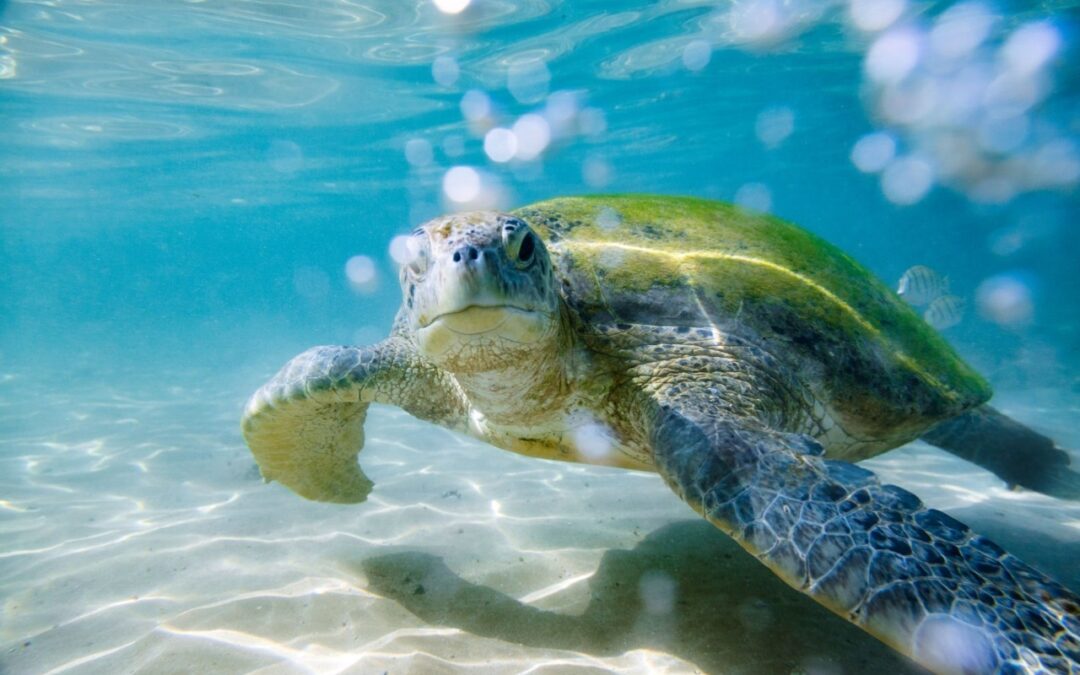
A remote Pacific atoll once owned by Hollywood legend Marlon Brando has evolved into one of French Polynesia’s notable marine conservation sites, with thousands of sea turtle hatchlings recorded following decades of habitat protection.
Biologists monitoring Tetiaroa Atoll documented more than 15,614 green sea turtle hatchlings emerging from nests during a recent monitoring season, according to figures released by conservation organisation Tetiaroa Society and its research partner Te mana o te moana. The annual survey, conducted between September and March, recorded 113 nesting females and around 161 nests across the atoll’s protected coral islets.
The remarkable numbers are the result of an environmental transformation that began nearly six decades ago in the South Pacific.
From Hollywood film location to private sanctuary
Brando first visited Tetiaroa in 1960 while searching for filming locations for MGM’s historical drama Mutiny on the Bounty. He was captivated by the secluded atoll, made up of 12 small islets surrounding a turquoise lagoon.
In 1966, Brando negotiated the purchase of the atoll’s land rights from descendants of American dentist Johnston Walter Williams. In his 1994 autobiography, Songs My Mother Taught Me, Brando recalled arriving by local fishing boat and described the remote paradise as “more gorgeous than anything I had anticipated”.
Rather than transforming Tetiaroa into a sprawling commercial resort, Brando wanted to preserve its isolation and natural beauty. He built a modest village on Motu Onetahi for his family and visiting scientists, laying the groundwork for long-term conservation and the protection of native Pacific wildlife.
Scientific research and removal of invasive species
Following Brando’s death in 2004, his estate partnered with Pacific Beachcomber to continue his environmental vision. Their efforts helped establish the Tetiaroa Society, an organisation dedicated to scientific research, Indigenous cultural preservation and environmental protection across tropical island ecosystems.
Scientists from several countries work out of the Ecostation on Motu Onetahi, studying issues including coral reef health, ocean acidification and native plant species.
A key part of the restoration effort has been eliminating introduced predators that posed a threat to ground-nesting seabirds and sea turtle nests. According to the Tetiaroa Society and international conservation partner Island Conservation, targeted programmes successfully eradicated invasive Pacific rats from islets including Reiono and Rimatuu.
The removal of the rats has allowed native plants and wildlife to recover with fewer threats. Researchers working with Tahiti’s Louis Malardé Institute have also explored methods of controlling mosquitoes without chemical pesticides that could damage the surrounding marine ecosystem.
Decades of monitoring reveal turtle success
The green sea turtle, known as honu in Tahitian, relies heavily on Tetiaroa’s secluded beaches as a breeding ground. Female turtles generally return to the beaches where they were born after 25 to 30 years, navigating with the help of ocean currents and Earth’s magnetic field.
Data collected by marine biology organisation Te mana o te moana provides a detailed picture of the latest nesting season:
- More than 430 turtle crawls were recorded along the atoll’s beaches.
- Researchers identified 113 individual female turtles coming ashore to lay eggs.
- A total of 161 nests were monitored, with hatchling numbers estimated by counting the empty eggshells left after the young turtles emerged.
- An estimated 15,614 hatchlings successfully reached the water.
Conservation efforts extend throughout the nesting cycle. Night patrols monitor beaches as females come ashore, while adult turtles are tagged so researchers can track their nesting patterns over several years. Nests are also protected from flooding and any remaining predators.
Luxury tourism helps finance conservation
Conservation at Tetiaroa is supported by a self-sustaining financial model centered on The Brando, a luxury eco-resort on Motu Onetahi.
The resort incorporates a range of environmental technologies, including a Sea Water Air Conditioning system that draws cold ocean water from a depth of 930 metres to cool buildings while reducing electricity consumption.
Revenue generated by the resort helps fund the boats, equipment, laboratory facilities and other resources required by the Tetiaroa Society. The organisation’s broader objective is to demonstrate that luxury tourism, scientific research and Indigenous Polynesian leadership can coexist while protecting fragile island ecosystems.
Threats remain beyond Tetiaroa’s protected waters
Despite the protection afforded to Tetiaroa’s nesting beaches, marine biologists warn that green turtles continue to face significant dangers once they leave the lagoon.
Satellite tracking has shown that female turtles can travel thousands of miles across the open ocean after the breeding season ends in April, reaching feeding grounds such as seagrass meadows around Fiji.
Along the way, they face hazards including industrial longline fishing gear, ingestion of marine plastic and rising ocean temperatures. Warmer conditions can also affect nesting beaches because sand temperature influences the sex of developing turtle embryos.
Conservationists say safeguarding nesting sites such as Tetiaroa and eliminating invasive predators gives Pacific green turtles a crucial advantage. Large numbers of hatchlings can help offset the high losses young turtles experience during their lives at sea.
The emergence of more than 15,000 hatchlings in a single season is a striking measure of how decades of protection have transformed an atoll that was once a private retreat into a thriving sanctuary for Pacific wildlife.