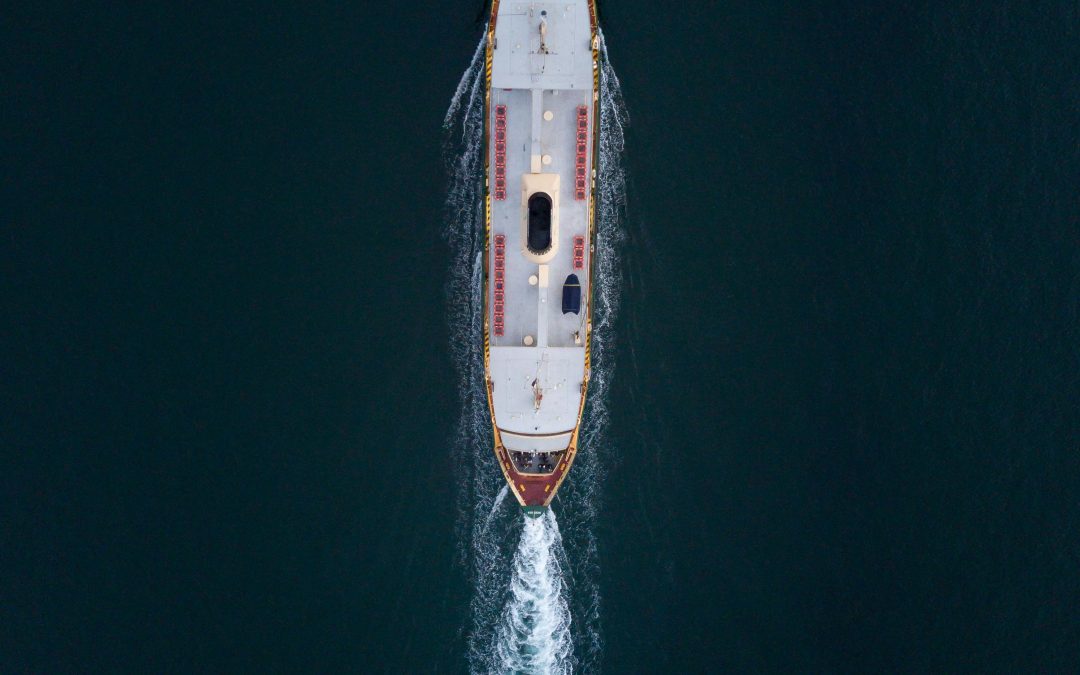
Air quality screenings recorded at the port of Ilulissat in Greenland show high air pollution levels with an average around 60-70 times higher than safe low particle levels recommended by the World Health Organization (WHO) of 1,000 particles/cm3.
The measurements, taken by Dr Kåre Press-Kristensen, senior advisor on air quality & climate at Green Global Future, found average concentrations in Ilulissat port between 60,000 and 70,000 particles/cm3 (with peaks above 200,000), suggesting that port workers and residents are regularly exposed to high levels of toxic air pollution, particularly when wind blows from the port towards residential areas.
Such pollution increases the risk of strokes, cardiovascular diseases, lung diseases, cancer, and as a result, the risk of premature mortality. In addition, soot particles are a key driver for global warming. See WHO info on health risks.
The findings demonstrate health risks to residents and workers, underlining the need for electrification of port equipment in Greenland, along with onshore power for domestic vessels to reduce port pollution and climate warming.
The measurements, made between July 29th and August 7th 2026, contained a high number of ultrafine particles with a high content of soot (black carbon) which is both toxic to human health and a strong climate pollutant that drives warming of the Arctic. Although levels have not been measured, it is likely that the same high pollution levels will be present in other Greenlandic ports where port side electrification has yet to be installed.
In addition to daily pollution within ports, cruise ships contribute significantly to air pollution in Greenlandic cities when running their engines all day in ports or at anchor. A large cruise ship emits as much toxic air pollution as 3,000-5,000 cars per second.
“Greenland and other Arctic nations have a great potential to produce pollution free renewable electricity (hydro, solar and/or wind), and to cut both air pollution and their dependence on fuel prices fluctuating with the situation in the Middle East”, said Dr Kåre Press-Kristensen. “Electrification of port equipment and onshore power for vessels are also important steps to consolidate fishing and export of seafoods. However, to rapidly reduce emissions at sea, ships operating in Greenland’s waters and throughout the Arctic must switch to distillate fuels – increasingly identified as polar fuels – such as marine gas oil, which is already used by Greenland-flagged vessels.”
“Greenland can promote this by continuing to support a proposal on polar fuels at the International Maritime Organization; banning scrubber water discharges in territorial seas as recommended by OSPAR and as other Nordic nations have done; as well as by establishing a green corridor between Nuuk and Reykjavik, thereby protecting the fragile Arctic ecosystems”, added Press-Kristensen. “The expense of electrification of ports will be recouped through fuel oil savings. This will eliminate local pollution from ships at berths, improve public health in the wider vicinity and reduce global warming.”
Greenland and Emission Control Areas
“The Northeast Atlantic Emission Control Area (ECA) adopted by the IMO on May 1st this year is a welcome step towards reducing emissions of air pollutants SOx and NOx, but it will not adequately address black carbon emissions which lead to climate heating in the Arctic. This is because ships can still use traditional heavy fuel oils in combination with scrubbers or ultra low sulphur fuel oils to comply with the sulphur requirements in the ECA but which emit high levels of black carbon”, said Dr Sian Prior, Lead Advisor to the Clean Arctic Alliance. “Both these compliance methods will not reduce black carbon emissions to the same low levels that using polar fuels can do.”
A proposal on polar fuels, co-sponsored by Denmark, Germany, France and the Solomon Islands is currently on the table at the International Maritime Organization.
“The Clean Arctic Alliance is calling on other Arctic countries to support Denmark in the creation of this new regulation requiring the use of cleaner maritime fuels in order to protect the Arctic”, added Prior. “It is important that the regulation is applied within the area used as the basis of the Arctic Monitoring and Assessment Programme (AMAP) by the Arctic Council – in order to maintain a level playing field across the whole Arctic since black carbon emissions can be transported hundreds to thousands of kilometers in the atmosphere and when emitted further south can settle on to Arctic snow and ice.”
Background: Heavy Fuel Oil Ban
July 1, 2026, marked two years since an IMO ban on the use and carriage for use of heavy fuel oil came into force in the Arctic to address the risk of HFO spills, but it won’t be fully in place until July 2029 and even then will only apply to waters where sea ice can be encountered.
In May 2025, Greenland shipping firm Royal Arctic Line announced it would end use of heavy fuel oil.
In 2026, the North-East Atlantic Emission Control Area (ECA) was adopted by the International Maritime Organization (IMO) on May 1st, 2026 to address SOx and NOx emissions, and will take effect until March 2027. Although crucially important, neither of these regulations will specifically address the Arctic’s black carbon problem. Switching to clean fuels – marine gas oils or new low carbon fuels coming onto the market – will further reduce emissions of black carbon, which is why Greenland’s backing of the polar fuel proposal led by Denmark is important.
The report Black Carbon Emissions from Ships in the Arctic 2019 – 2024 provides a comprehensive analysis of tank-to-wake black carbon emissions from Arctic shipping using three geographic definitions: a latitudinal band north of 60oN (excluding the Baltic Sea and Gulf of Alaska), the Polar Code Arctic waters, as well as a broader ecological boundary defined by the Arctic Monitoring and Assessment Programme (AMAP). It estimates black carbon emissions for the years 2019, 2022 and 2024. The report examines the seasonal patterns of Arctic shipping routes, profiling vessel characteristics, fuel consumption by EEZ and vessel type as well as energy use. Historical estimates show how Arctic shipping activity and associated emissions have changed over time, while forecasts reveal how growth in emissions could affect the Arctic, and inform decisions on fuel choices, such as that proposed by PPR 13/6, operational practices and regulatory strategies.
Source: Clean Arctic Alliance