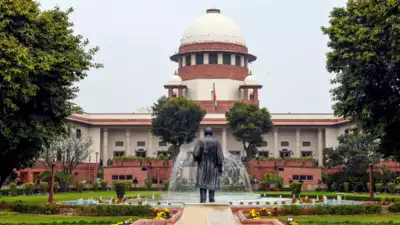
NEW DELHI: The Supreme Court on Friday barred the uploading, sharing and circulation of video clips from its live-streamed proceedings on social media and other digital platforms without prior approval, citing the growing misuse of edited courtroom footage accompanied by misleading commentary.
A bench comprising Chief Justice of India Surya Kant and Justices Joymalya Bagchi and V Mohan passed the interim order while hearing a public interest litigation filed by journalist Harshita Grover. The court observed that excerpts from judicial proceedings were being selectively edited and circulated online in a manner that distorted the context and undermined public confidence in the judiciary.
Senior advocate Vikas Singh, appearing for the petitioner, told the court that several clips circulating on social media had been edited with “a devious mind” and were overlaid with misleading narratives to portray the judiciary negatively.
Supporting the plea for a regulatory framework, Solicitor General Tushar Mehta said the growing use of artificial intelligence had significantly amplified the spread of motivated and misleading content, posing a serious risk to the judiciary’s reputation.
The court issued notices to the Centre, all high courts and major social media platforms, including YouTube, X, WhatsApp, Facebook and Instagram, seeking their responses within two weeks.
“As an interim measure, no excerpts from live-streamed judicial proceedings shall be posted, transmitted, stored, hosted or circulated on any social media or digital platform without prior permission of the Secretary General of the Supreme Court or the Registrars General of the respective High Courts,” the bench ordered.
During the hearing, Singh, who is also president of the Supreme Court Bar Association, expressed concern that some lawyers were posting clips of court proceedings involving themselves on social media to enhance their visibility and attract clients.
Taking note of the submission, the court sought a response from the Bar Council of India, observing that the Advocates Act prohibits lawyers from directly or indirectly advertising or soliciting clients.
The bench was also informed that several law firms now engage public relations professionals to secure media coverage and include lawyers’ comments in news reports.
The court remarked that the misuse of courtroom footage had become so widespread that it had considered restricting the live streaming of judicial proceedings altogether.
“If the digital data generated from court hearings, once made public, becomes impossible to regulate, we will consider restricting live streaming of court proceedings. We do not want it to become a 24×7 entertainment channel. It is trivialising the judiciary,” the bench observed.
When the court suggested that access to live-streamed proceedings could be limited to advocates and litigants on request, Singh urged that live streaming should continue, arguing that it promotes transparency in the judicial process.
The petitioner contended that while fair reporting of court proceedings is protected under Article 19 of the Constitution, that protection does not extend to content that spreads misinformation, interferes with the administration of justice or fuels organised campaigns to vilify judicial institutions.
“Misleading thumbnails, clickbait headlines, provocative commentary and edited courtroom clips encourage sensationalism rather than accurate reporting. These practices distort public understanding of judicial proceedings and erode confidence in the justice delivery system,” the petition stated.