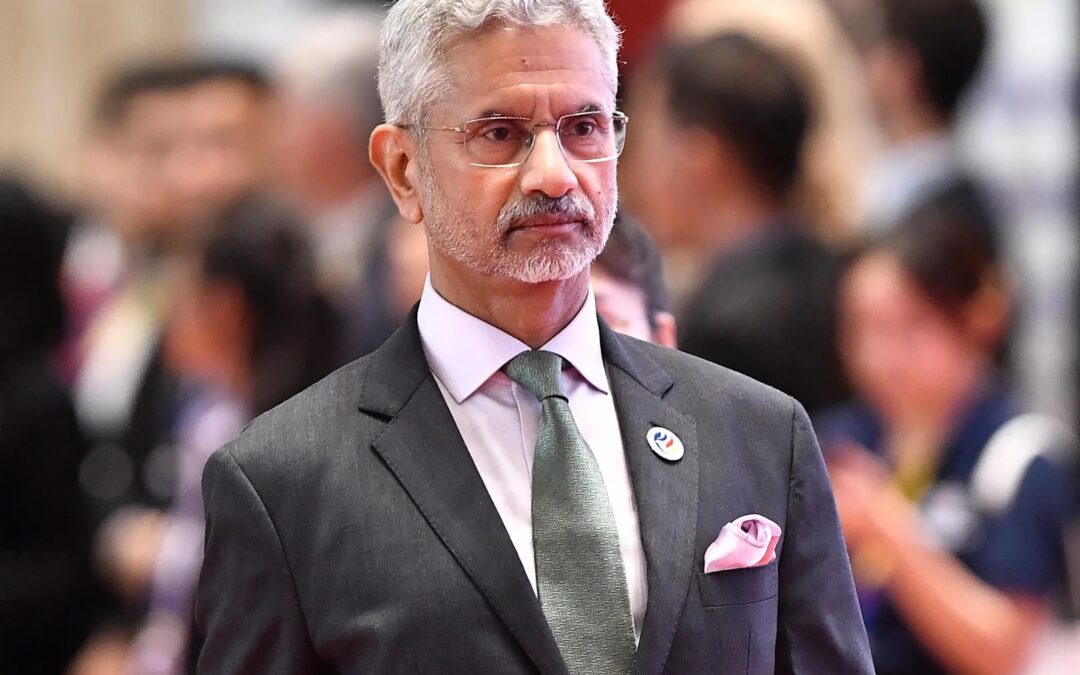
India on Monday officially launched its campaign for election as a non-permanent member of the United Nations Security Council (UNSC) for the 2028-29 term, with external affairs minister S Jaishankar outlining the country’s vision for a more inclusive, peaceful and rules-based global order.
Speaking at the launch of India’s candidature at the UN headquarters in New York, Jaishankar said the bid comes at a time when the world is grappling with growing conflicts, instability and geopolitical divisions, underscoring the importance of the United Nations and the Security Council.
“It is a pleasure to join you this afternoon to launch India’s candidature to serve as a non-permanent member of the United Nations Security Council for the term 2028-29. We do so at a time when the world is facing a profound paradox,” Jaishankar said.
“At the same time, we are witnessing levels of conflict, violence and instability that threaten even those who may be very far away,” he added.
India outlines SHANTI vision
Presenting India’s approach to global governance, Jaishankar introduced the SHANTI vision — Securing Holistic Advancement through Norms, Trust and Integrity — as the guiding framework for the country’s UNSC campaign.
He said lasting peace, development and prosperity require stronger adherence to international norms, mutual trust and a commitment to integrity.
“Recent developments have only demonstrated that peace, progress and prosperity cannot be sustained in a fragmented manner,” Jaishankar said.
“The world must therefore focus on holistic advancement. That journey can only be undertaken effectively when global order is valued and rules are respected. This puts a premium on norms, trust and integrity. That is the approach India offers: ‘Securing Holistic Advancement through Norms, Trust and Integrity’ — SHANTI,” he said.
Jaishankar said India’s priorities at the Security Council would include promoting global peace and security, amplifying the voice of the Global South, strengthening UN peacekeeping, encouraging the responsible use of technology, and addressing challenges such as terrorism, climate change and maritime security.
“India’s focus will be on working for a secure, peaceful and equitable world — one where the voice of the Global South is heard in equal measure,” he said.
Highlights peacekeeping, development partnership
Making the case for India’s candidature, Jaishankar underscored the country’s long-standing contribution to UN peacekeeping operations.
“Peacekeeping has been a crucial element of maintaining international peace and security since the very inception of the United Nations. India has always been at the forefront of discharging that responsibility,” he said.
According to Jaishankar, India has deployed nearly 300,000 personnel across around 50 UN peacekeeping missions since the organisation’s founding. Currently, about 4,300 Indian personnel are serving in 10 of the UN’s 11 active peacekeeping missions.
He said India would continue advocating for better-equipped, technology-enabled and realistically mandated peacekeeping operations while supporting the UN’s Women, Peace and Security agenda.
Beyond peacekeeping, Jaishankar highlighted India’s role as a development partner, noting that India-funded projects are currently being implemented in 79 countries.
“In a world with too many conflicts and tensions, India has consistently espoused dialogue and diplomacy. We have sought to bridge differences and find common ground. Our focus has been on mitigating the impact of these developments for the Global South,” he said.
Seeks support for Security Council bid
If elected, India will serve as one of the 10 rotating non-permanent members of the Security Council alongside its five permanent members — China, France, Russia, the United Kingdom and the United States.
The 10 non-permanent members are elected by the 193-member UN General Assembly and require a two-thirds majority to secure a seat.
India will contest the single Asia-Pacific Group seat for the 2028-29 term against Tajikistan, with the election scheduled for June next year.
Seeking support for India’s candidature, Jaishankar said the country’s presence on the Security Council would strengthen the body’s decision-making through broader consultations and more representative participation.
“We believe that India’s presence in the Security Council will help strengthen decision-making in this vital body. We therefore seek your support for our candidacy,” he said.
India has previously served as a non-permanent member of the UNSC eight times — in 1950-51, 1967-68, 1972-73, 1977-78, 1984-85, 1991-92, 2011-12 and most recently in 2021-22.
The latest campaign comes as New Delhi continues to push for comprehensive reforms of the Security Council, arguing that its current structure, established in 1945, no longer reflects contemporary geopolitical realities.
India has repeatedly called for the expansion of both permanent and non-permanent categories of membership, maintaining that meaningful UNSC reform must address the existing imbalance in global decision-making.