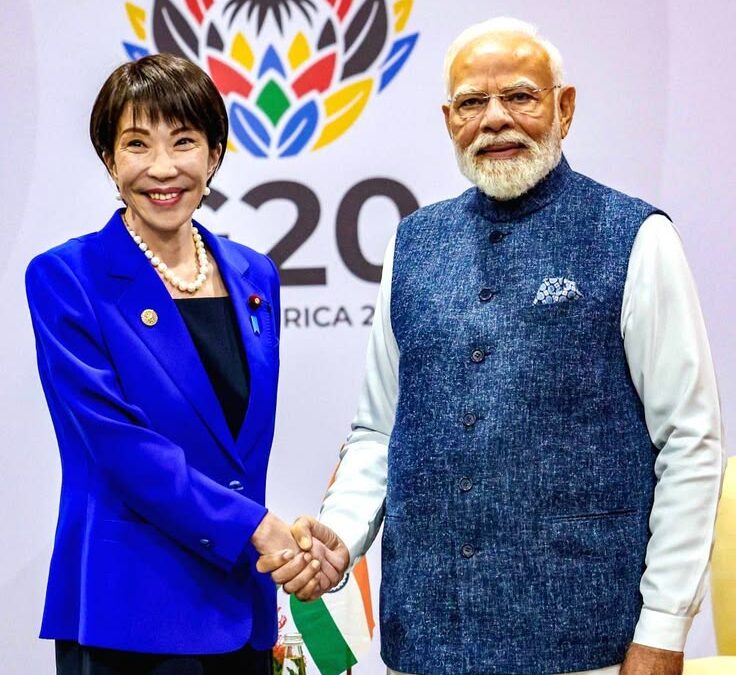
India and Japan have strengthened their strategic partnership by announcing a series of agreements covering defence, economic security, artificial intelligence, energy resilience, and critical supply chains during the 16th India-Japan Annual Summit in New Delhi. Japanese Prime Minister Sanae Takaichi, on her first visit to India since taking office, held bilateral talks with Prime Minister Narendra Modi and participated in a joint economic forum aimed at boosting investment and innovation.
The two leaders adopted a Joint Roadmap on Economic Security to enhance cooperation in strategic sectors such as semiconductors, critical minerals, pharmaceuticals, clean energy, and artificial intelligence. The roadmap is designed to strengthen resilient supply chains amid growing global economic and geopolitical uncertainties.
In the defence sector, India and Japan agreed to expand military cooperation through the joint development of defence technologies, increased military exercises, maritime domain awareness, and naval maintenance collaboration. A key agreement was signed for the joint development of the Unicorn radio antenna system for Indian warships, including technology transfer.
Both nations also decided to modernise the Comprehensive Economic Partnership Agreement (CEPA), originally signed in 2011, to better reflect evolving global trade dynamics. Prime Minister Modi said India aims to attract 10 trillion yen in Japanese investment over the next decade while doubling the number of Japanese companies operating in the country.
The summit also produced agreements on AI research, battery supply chains, biogas projects, critical minerals, pharmaceuticals, and next-generation mobility. India and Japan pledged to collaborate on safe, secure, and human-centric AI while promoting innovation in deep technology and life sciences.
The leaders reaffirmed their commitment to the Mumbai–Ahmedabad High-Speed Rail project, with Japan reiterating its support for the project’s timely completion. They also expressed concern over rising tensions in the East and South China Seas and underscored the importance of maintaining a free, open, and rules-based Indo-Pacific region.
The summit highlighted the growing strategic alignment between India and Japan, with both countries reaffirming their commitment to strengthening regional stability, economic resilience, and technological cooperation.