The United States Air Force is pursuing a next-generation long-range missile that could significantly reshape aerial warfare by enabling aircraft to engage targets at unprecedented distances.
Under its Air Force Long Range Weapon (AFLRW) programme, the US Air Force Life Cycle Management Center is seeking an air-launched standoff weapon with a minimum operational range of 1,000 nautical miles (approximately 1,850 kilometres). The programme includes both air-to-air and air-to-surface variants, with initial emphasis placed on the air-to-air version.
To advance the project, the Air Force has scheduled a closed-door meeting with defence industry representatives on August 25–26, 2026, at the Guided Weapons Evaluation Facility at Eglin Air Force Base. The discussions will focus on developing the system for classified operational scenarios identified as defence planning scenarios 2.1 and 7.1.
A Major Leap in Missile Range
If developed, the proposed missile would far exceed the range of existing and currently planned air-to-air weapons.
Among the world’s longest-range operational missiles, China’s PL-17 is reported to have a range of around 400 kilometres and is designed primarily to engage high-value airborne assets such as airborne early warning and control (AEW&C) aircraft.
Russia’s R-37M, capable of speeds of around Mach 6, has an estimated range of approximately 300 kilometres.
The United States is also developing the AIM-260 Joint Advanced Tactical Missile (JATM), expected to exceed 200 kilometres in range and eventually replace the AIM-120 AMRAAM, whose range is estimated at about 160 kilometres.
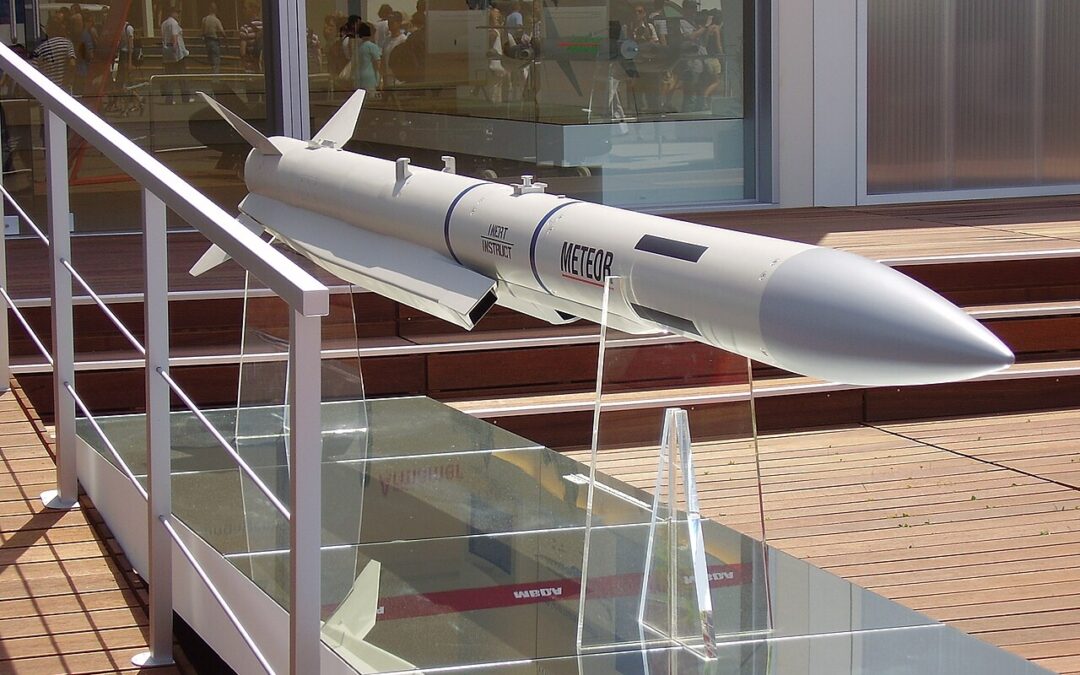
China’s PL-15 and Europe’s Meteor missile also offer engagement ranges approaching 200 kilometres, while India’s Astra missile family is reported to provide stand-off capabilities ranging from 160 to 350 kilometres, depending on the variant.
Pacific Theatre Driving Requirement
The US Air Force’s interest in an ultra-long-range missile is largely driven by the vast operational distances of the Indo-Pacific region.
As China continues to expand the reach of its long-range air-to-air weapons, American planners believe a substantially longer-range missile could help restore a strategic advantage in future air combat.
However, engaging targets nearly 2,000 kilometres away presents major technical challenges.
A missile with such a range would far exceed the radar horizon of conventional airborne early warning and control aircraft. Even when operating at high altitude, these aircraft can generally detect targets only up to around 550 kilometres, as the Earth’s curvature limits radar coverage.
Networked Sensors Could Enable Long-Range Engagements
Air Vice Marshal Anil Golani, Director General of the Centre for Air Power Studies, said the concept is technically feasible if supported by a modern network-centric battle management system.
“Such a weapon is within the realm of reality. A modern air-defence system is based on a kill web, the multiple nodes of which in a network-centric system can detect a target and guide a weapon towards it. Range here is not an issue; the limiting factor is sensors,” he said.
Military analysts note that future long-range engagements are likely to depend on integrated networks linking satellites, aircraft, drones, ground-based radars and other sensors capable of tracking targets beyond the line of sight and relaying guidance data to the missile throughout its flight.
Strategic Implications
The AFLRW programme reflects the United States’ growing emphasis on extending its long-range strike capabilities amid evolving security challenges, particularly in the Indo-Pacific.
In addition to the missile programme, the US is reportedly exploring space-based surveillance systems that could eventually augment or replace portions of its airborne early warning capability through satellite constellations. Although those efforts remain under development, such systems could provide the sensor coverage needed to support engagements at ranges approaching 2,000 kilometres.
If successfully developed, the AFLRW would represent one of the most significant advances in air-to-air missile technology, potentially redefining beyond-visual-range combat and long-distance aerial engagements.