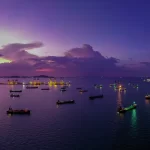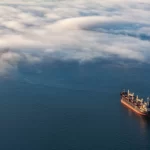
The flow of vessels exiting the Persian Gulf through the Strait of Hormuz is improving, but questions remain about the safety and specified routes for passage.
On Wednesday, the International Maritime Organization (IMO) said it developed an evacuation plan for the more than 11,000 seafarers still stranded in the region.
“This large-scale operation will be carried out in close cooperation with Iran, Oman, all other coastal states in the region, the US and the maritime industry,” the IMO said.
Then on Thursday, the United Kingdom Maritime Trade Operations (UKMTO), which operates under the UK Royal Navy, announced the suspension of the IMO-supported process until further notice.
The suspension was likely a response to a report of an incident southeast of Dahit, Oman, where a cargo vessel was hit on the starboard side by an unknown projectile, causing damage to the bridge.
Lars Jensen, president of consultancy firm Vespucci Maritime, said the Iranian Navy was warning vessel operators against using a new route to transit the Strait.
“They furthermore stated that only routes designated by Iran are authorized and vessels sailing outside those corridors would face enforcement action,” Jensen said.
Jensen suggested Iran may have been referring to a route that Oman opened in coordination with the IMO, shown in the following image.
Jensen said that vessels seen transiting the Strait appear to not be using the new corridor, but are either transiting closer to the Omani coastline, or in the north closer to Iran.
The IRGC Navy said safe navigation through Hormuz is only possible on routes officially designated by the Islamic Republic of Iran, according to Iran’s Mehr News Agency.
News
The statement stressed that the only authorized routes for transit through the Strait of Hormuz are those officially designated by Iran, warning that navigation outside these routes is prohibited and poses serious risks, urging all vessels to refrain from any transit beyond the announced corridors.
Peter Sand, chief analyst for ocean and freight rates and analytics firm Xeneta, said the container shipping industry is focused on vessels trapped in the Persian Gulf.
“After months of very few containership transits, Wednesday saw seven transits recorded,” Sand said.
Sand said only one was inbound to the Persian Gulf, indicating that the industry is still on a mission to bring trapped seafarers out of the region, rather than re-establishing networks.
“Reconnecting container services requires a fundamentally different risk assessment than one-off transits by other vessel types,” Sand said. “Carriers need a safe, permanent corridor before they will commit networks, and we are not there yet.”
BACKGROUND
Transits through the Strait have been essentially halted since late February when the US and Israel attacked Iran.
The closure has had significant impact on crude oil and chemical markets as around one-third of global seaborne crude flows and up to 20% of the world’s total oil flows pass through.
The closure has had less impact on container shipping as less than 2% of global container capacity passes through the Strait each year but has contributed to higher rates mostly because of surging bunker fuel prices.
Container ships and costs for shipping containers are relevant to the chemical industry because while most chemicals are liquids and are shipped in tankers, container ships transport polymers, such as polyethylene (PE) and polypropylene (PP), which are shipped in pellets. Titanium dioxide (TiO2) is also shipped in containers.
Economics
They also transport liquid chemicals in isotanks.
Source: ICIS