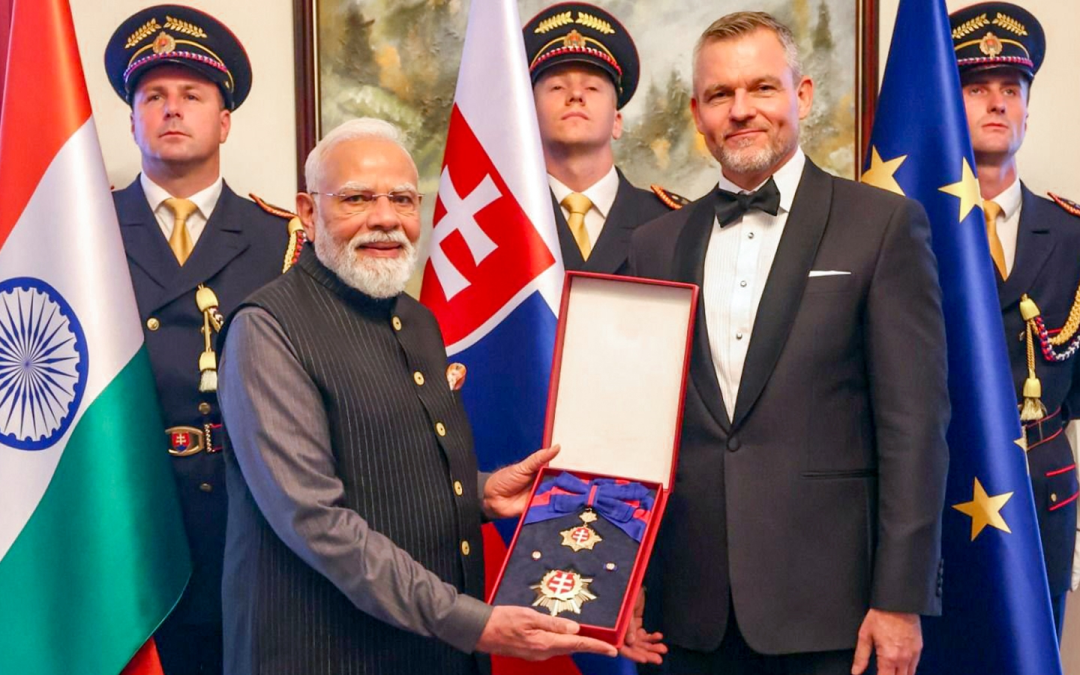
India and Slovakia have elevated their bilateral relationship to a Comprehensive Partnership, marking a significant step forward in diplomatic and economic ties during Prime Minister Narendra Modi’s historic visit to the Central European nation. The move was announced after extensive talks between Prime Minister Modi and Slovak Prime Minister Robert Fico on Monday.
Modi’s visit is particularly noteworthy as he became the first Indian Prime Minister to visit Slovakia since the country gained independence in 1993. The leaders agreed to deepen cooperation across a wide range of sectors, including defence, digital technology, cybersecurity, labour mobility, higher education, and counter-terrorism.
Addressing a joint media briefing, Modi described the upgraded partnership as a reflection of the growing trust and shared priorities between the two nations. He highlighted opportunities for greater collaboration in industries such as automobiles, railways, advanced manufacturing, artificial intelligence (AI), and space technology.
One of the key outcomes of the visit was the signing of a Letter of Intent on defence cooperation. The agreement aims to strengthen joint research, development, production, and industrial collaboration between the defence sectors of both countries. Modi emphasized that the pact would create new avenues for defence innovation and strategic cooperation.
The two leaders also discussed expanding collaboration in space and civil nuclear energy. Modi recalled that Slovakia’s first satellite was successfully launched by India in 2017, underscoring the existing partnership in the space sector. Both sides agreed to encourage greater interaction between industry experts and institutions involved in nuclear energy development.
Labour mobility emerged as another important area of cooperation. India and Slovakia signed a Memorandum of Understanding (MoU) on labour migration, which is expected to facilitate the movement of skilled professionals and workers between the two countries. Modi also announced that discussions on a social security agreement are progressing and are likely to be finalized soon.
In the digital domain, the two nations signed an MoU focused on digital technologies, including artificial intelligence and digital public infrastructure. Another agreement on quantum communication and the protection of critical infrastructure aims to enhance cooperation in cybersecurity and emerging technologies. Educational ties also received a boost with an MoU on higher education and a separate agreement between the Indian Institute of Technology (IIT) Delhi and Slovak Technical University. The partnership will promote academic exchanges, scholarships, and collaborative research projects.
Prime Minister Fico reiterated Slovakia’s support for strengthening multilateral institutions and endorsed India’s aspiration for permanent membership in an expanded United Nations Security Council. He also welcomed progress in negotiations on the India-European Union Free Trade Agreement (FTA), expressing optimism that Slovakia’s automobile industry would benefit significantly from the deal. Additionally, he encouraged greater Indian investment in Slovakia, particularly through public-private partnership projects.
Security and counter-terrorism cooperation featured prominently in the discussions. The two countries agreed to establish a Joint Working Group on Counter-Terrorism and initiate a dedicated consular dialogue. A joint statement issued after the talks called for stronger international cooperation against terrorism and urged decisive action against terrorist organizations, their sponsors, supporters, and affiliated networks.Modi’s visit to Slovakia forms part of his broader European tour. Following the visit, he is scheduled to participate in the outreach sessions of the G7 Summit in France and hold bilateral meetings with several global leaders, including US President Donald Trump.
The elevation of India-Slovakia relations to a Comprehensive Partnership signals a new chapter in bilateral engagement, with both nations seeking deeper cooperation in strategic, technological, economic, and security-related fields.