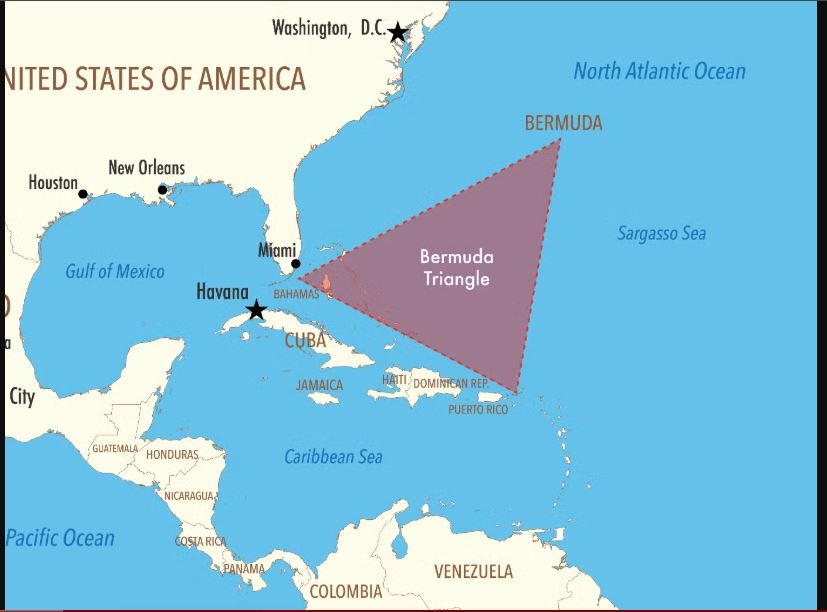
Scientists have uncovered a massive and unusual rock layer deep beneath Bermuda, a discovery that could help explain one of the region’s biggest geological mysteries and renew fascination with the legendary Bermuda Triangle.
The findings, published in the journal Geophysical Research Letters, reveal a thick, low-density rock formation located roughly 20 kilometres beneath the Bermuda Islands. Researchers say the structure is unlike anything previously identified beneath other mid-ocean islands.
While the discovery does not support theories involving aliens, portals or supernatural forces often linked to the Bermuda Triangle, scientists say it offers a genuine geological explanation for why Bermuda has remained elevated above the Atlantic Ocean long after its volcanic activity ended millions of years ago.
Hidden Rock Layer Beneath Bermuda
Researchers from Carnegie Science and Yale University used seismic imaging techniques to study the Earth beneath Bermuda.
By analysing earthquake waves travelling through the crust and mantle, scientists created a 3D image of the underground structure and discovered a thick buoyant layer of rock sandwiched between the oceanic crust and the mantle.
Geologists believe this unusual formation may act like a natural platform or “life raft”, preventing Bermuda from sinking despite the extinction of its volcanoes around 30 to 40 million years ago.
Normally, volcanic islands gradually subside after their magma supply disappears. However, Bermuda has remained relatively stable, puzzling scientists for decades.
Researchers now suspect that during Bermuda’s final volcanic phase, magma accumulated beneath the island and later cooled into a thick, lightweight rock layer that continues to support it today.
The study’s authors described the structure as unprecedented, saying such rock thickness had never been observed beneath similar ocean islands.
Bermuda Triangle Myths Revisited
The discovery has reignited public interest in the Bermuda Triangle, the region in the western Atlantic long associated with stories of vanished ships, missing aircraft and mysterious compass behaviour.
Legends surrounding the area were fuelled by incidents such as the disappearance of Flight 19, a squadron of US Navy bombers that vanished during a training mission in 1945.
However, scientists and agencies such as the US Coast Guard have repeatedly stated that there is no evidence the Bermuda Triangle is more dangerous than other heavily travelled parts of the ocean.
Most disappearances have been attributed to natural causes such as hurricanes, rogue waves, navigational errors, equipment failures and human mistakes.
Researchers emphasised that the newly discovered rock structure has no known connection to aircraft crashes, ship disappearances or magnetic anomalies often linked to Bermuda Triangle folklore.
New Questions for Geologists
The discovery could reshape scientific understanding of how ocean islands form and survive over millions of years.
Some scientists believe the structure may date back to ancient geological processes linked to the breakup of the supercontinent Pangaea, while others suspect unusual magma chemistry beneath the Atlantic may have played a role.
The findings have also raised new questions, including whether similar hidden structures may exist beneath other islands and how Bermuda’s underground platform became so thick.
For now, researchers say the discovery replaces myth with a different kind of mystery — one grounded not in supernatural speculation, but in measurable geological evidence buried deep beneath the Atlantic Ocean.