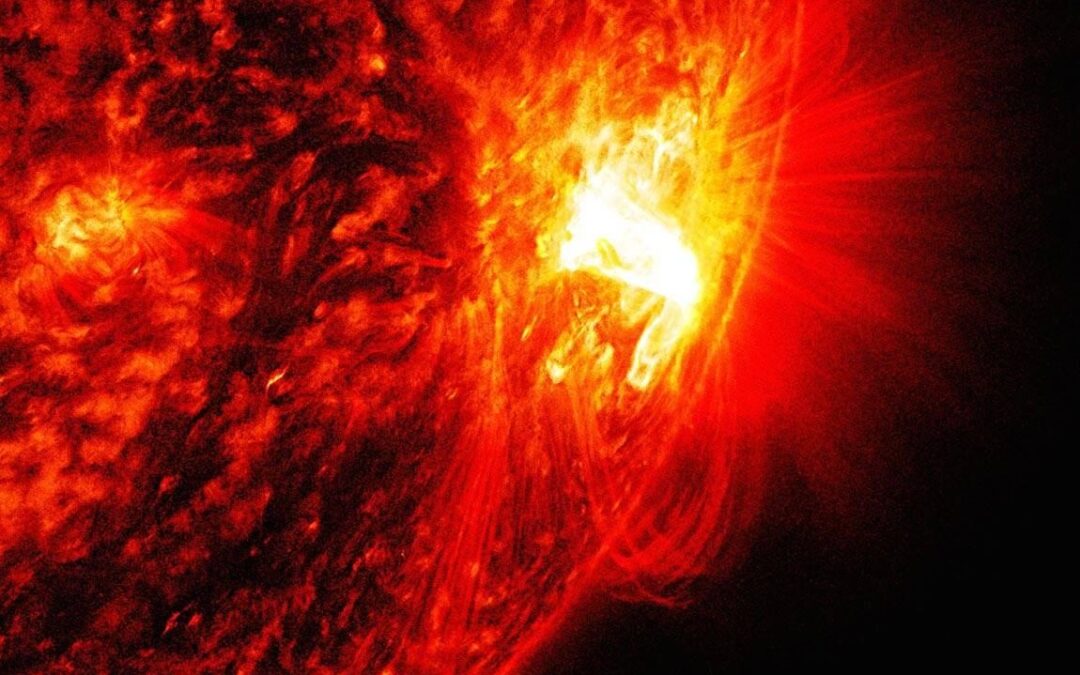
In a breakthrough for space science, NASA’s Parker Solar Probe has captured the first direct, close-range measurements of the exact moment solar storms are triggered—an event known as magnetic reconnection.
What the probe discovered
The spacecraft flew directly through a magnetic reconnection event, where oppositely directed magnetic field lines snap and reconnect. This explosive process releases massive amounts of energy, accelerating charged particles—such as protons and heavy ions—away from the Sun at extremely high speeds.
Scientists confirmed that these events occur within the Heliospheric Current Sheet, often described as the Sun’s “magnetic equator.” This region plays a key role in shaping solar activity across the solar system.
A surprising particle behavior
One of the most unexpected findings was how differently particles behave after these explosions:
- Protons scatter widely due to plasma waves, spreading out like a flashlight beam
- Heavy ions remain tightly focused, travelling in straight, high-energy paths like a laser
This “flashlight vs. laser” effect challenges long-standing theories, which assumed all charged particles would accelerate in similar ways.
The findings, led by Mihir Desai and published in The Astrophysical Journal Letters, suggest a more complex mechanism behind solar particle acceleration than previously understood.
Why this matters for Earth
Understanding how solar storms form is critical because they can directly impact life on Earth. These storms—often referred to as space weather—can:
- Disrupt GPS and communication systems
- Damage satellites and onboard electronics
- Trigger power grid failures by inducing electrical currents
By decoding the exact “spark” that creates these storms, scientists can significantly improve forecasting models, helping protect vital infrastructure.
A step toward better space weather prediction
The Parker Solar Probe’s close-up observations offer an unprecedented look at the Sun’s most violent processes. With better models of magnetic reconnection, researchers hope to predict solar storms earlier and more accurately—giving governments and industries time to prepare for potential disruptions.
In essence, the mission has moved scientists closer to answering a long-standing question: how solar storms are born—and how we can anticipate them before they hit Earth.