Rates for shipping containers from Asia to the US were mostly higher this week, while the US government is considering waiving the Jones Act to help lower crude oil prices amid the US-Iran conflict, and the Federal Maritime Commission (FMC) is looking at surcharges on American shippers from carriers to make sure they do not violate US law.
CONTAINER RATES
Container rates were mostly higher this week, with costs to the West Coast between $1,750/FEU (40-foot equivalent unit) and $2,500/FEU, and costs to the East Coast between $2,500/FEU-$3,080/FEU.
Rates at online freight shipping marketplace and platform provider Freightos rose by 10% to the West Coast and fell by 9% to the East Coast.
Judah Levine, head of research at Freightos, said disruptions from the closure of the Strait of Hormuz have been limited to containers already headed to the region of stuck in Gulf ports.
“Ports in countries like India and Bangladesh – significant exporters to the Gulf states – are reporting backlogs,” Levine said. “And yard utilization levels are increasing at transshipment hubs in Asia where some Gulf-bound containers are now being diverted.”
Levine said that yard density at those ports could increase somewhat in the coming days as shippers who so far decided to wait and see may choose to divert Gulf-bound containers there as the Strait remains closed.
Rates from supply chain advisors Drewry rose slightly to both coasts, as the ongoing Middle East conflict continues to affect global supply chains, supporting higher freight rates in the short term. According to Drewry’s Container Capacity Insight, seven blank sailings have been announced for the next week on the transpacific East and West Coast trade routes. Drewry expects spot rates on this trade to increase in the coming weeks.
Rates from ocean and freight rates analytics firm Xeneta were slightly lower compared with the previous week.
Peter Sand, Xeneta chief analyst, said the ongoing conflict in the Middle East continues to send shockwaves through ocean supply chains.
“Carriers have cancelled services into the Arabian Gulf, but supply chains do not stop. Some shippers simply cannot pull the plug – they need their cargo to keep moving,” Sand said. “Alternative ports like Nhava Sheva in India are being used as temporary storage and transshipment points, bringing cargo closer to the Gulf. Congestion is building and is toxic for supply chains as carriers and shippers try to identify the least worst option for their cargo.”
Rates from global logistics company Freight Right on its TrueFreight Index (TFX) were down slightly this week.
Robert Khachatryan, founder and CEO of Freight Right Logistics, said the anticipated free fall in rates following the Lunar New Year holiday has not materialized, and pricing remains at or near carrier breakeven levels.
Rates on the New York Shipping Exchange Freight Index (NYFI) edged slightly higher this week while rates on the Shanghai Containerized Freight Index (SCFI), which tracks rates for containers leaving Shanghai, surged by almost 15%.
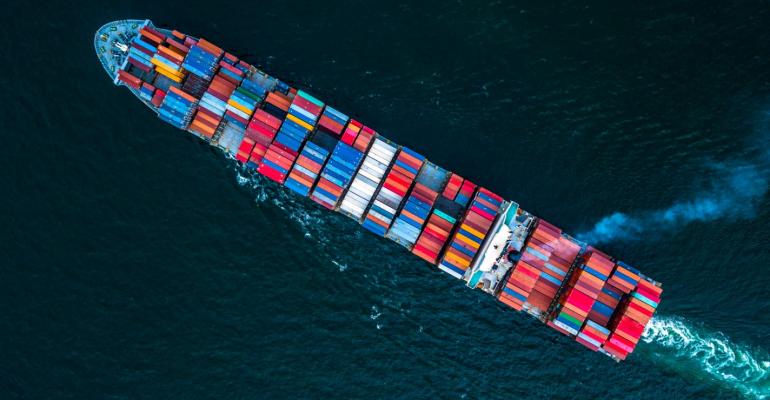
Container ships and costs for shipping containers are relevant to the chemical industry because while most chemicals are liquids and are shipped in tankers, container ships transport polymers, such as polyethylene (PE) and polypropylene (PP), are shipped in pellets. Titanium dioxide (TiO2) is also shipped in containers.
They also transport liquid chemicals in isotanks.
JONES ACT WAIVER BEING CONSIDERED
US President Donald Trump was said to be considering waiving the Jones Act amid efforts to slow soaring crude oil prices, according to multiple media reports.
There was nothing official from the government as of mid-afternoon on Friday.
The Jones Act, established by the Merchant Marine Act of 1920, requires that all vessels moving goods between US ports must be built in US shipyards, owned by companies with at least 75% American ownership, registered under the US flag, and crewed primarily by American citizens.
The law allows waivers in times of crisis, typically when national defense or emergencies make adherence impractical.
A potential 30-day exemption would apply largely to vessels carrying oil, gasoline, diesel, LNG and fertilizer.
FMC LOOKING AT SURCHARGES FROM CARRIERS
The FMC said this week it is closely monitoring what effects the conflict in the Middle East is having on shipping conditions through the Strait of Hormuz.
“Under its statutory authority, the commission ensures that rates, charges, and rules that common carriers have implemented as a result of the threats to commercial shipping in the Strait and neighboring waters do not violate the Shipping Act,” the FMC said.
Commission regulations require common carriers to provide at least 30 days between the publication and effective date of a change to a tariff that results in an increased cost to shippers.
The Alliance for Chemical Distribution (ACD) has encouraged the FMC and the Surface Transportation Board (STB) to scrutinize carriers for the recent rise in surcharges in response to the military conflict in the Middle East.
ACD also raised concerns about the additional rail surcharges that could follow, which would further impact the US supply chain and economy.
In the letter to the FMC, Eric R Byer, ACD president and CEO, highlighted how its members have already received surcharges from ocean carriers, citing fuel costs and risks associated with the conflict – even for routes outside of the Middle East.
“ACD is particularly concerned about the rise in surcharges, given the history of ocean carriers leveraging crises to increase profits rather than recovering costs,” Byer said.
The ACD’s letter to the STB warned against the additional surcharges its members could face from freight rail.
“These issues significantly impact intermodal shipments, as freight rail carriers often impose additional surcharges, forcing intermodal shippers to pay a second wave of fees,” Byer said. “The ambiguity in regulatory oversight of rail carriers during intermodal shipments makes this a difficult issue for shippers, who have little recourse when these surcharges may be improper.”
LIQUID TANKER RATES RISE ON MIDDLE EAST CONFLICT
Rates for chemical tankers ex-US Gulf were higher this week on most trade lanes assessed by ICIS, as they continue to face upward pressure.
The ongoing conflict in the Middle East continues to pressure freight rates globally to climb higher. Most players are now challenged with considering whether to reposition vessels or their cargoes if even at all possible.
On the USG-Brazil trade lane, this market has been completely dependent on contract volumes to keep steady employment. The spot market remains quiet mainly due to the lack of open space, leaving most charterers focused on their regular contractual volumes. Once again larger parcels of ethanol and MEG have been frequently indicated in the market for April loadings.
Similarly, rates from the USG to ARA have jumped due to higher bunker fuel prices and extremely limited open space. Several traders are rumored to be shipping on two different vessels in order to properly secure the space. However, most charterers have been reported to be moving smaller parcels of various products such as VAM, MEG, lube oils, and phenol by utilizing their contracted vessels.
The USG-Asia is no different than other trades lanes as most regular owners have very limited space with only pockets available for the balance of the month into the first part of April. As result rates have increased as most of the cargoes seem to be moving under contract. Although, a large parcel of EDC and glycols were said but fixed for the second half of March, while there still seems to be inquiries for other EDC, ethanol, and MEG cargoes in April.
On the USG-India route, there seems to be less interest in offering into the region due to the ongoing conflict in the Middle East. As a result, spot rates seem to be pressured higher as owners are offering unrealistic levels and mainly focused on steady contract volumes.
Bunker prices are pressuring freight rates higher, as price fluctuation is causing the markets to firm globally. Several owners are considering adding a bunker escalating clause into transactions or to simply raise rates to include the costs into the rates.
Source: By Adam Yanelli, Additional reporting by Kevin Callahan, ICIS