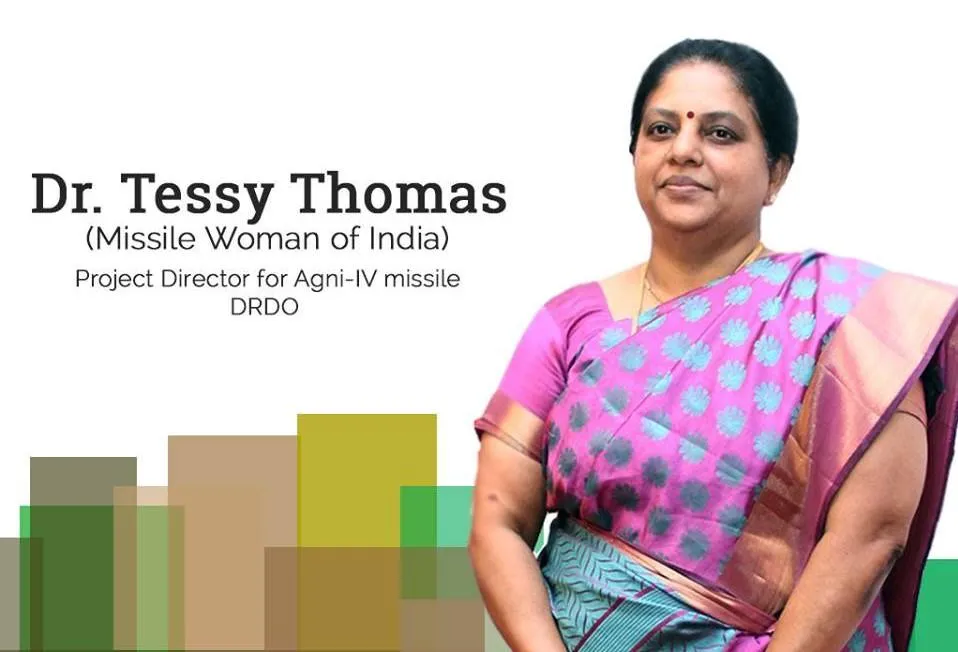
The title “Missile Woman of India” is widely associated with Tessy Thomas, one of the leading scientists behind India’s long-range ballistic missile development. Known for her key role in the Agni missile programme, she has contributed significantly to strengthening India’s strategic defence capabilities.
Her journey—from a curious child watching rockets launch in Kerala to becoming a senior scientist at the Defence Research and Development Organisation (DRDO)—is considered one of the most inspiring stories in Indian science.
Growing up near rockets and sea winds
Tessy Thomas was born in April 1963 in Alappuzha, a coastal town in Kerala. Her childhood unfolded not far from the Thumba Equatorial Rocket Launching Station, one of India’s earliest space research centres. Watching rocket launches from nearby left a lasting impression on her young mind.
Her family valued education deeply despite modest means. When Thomas was still young, her father suffered a stroke that left him partially paralysed. Seeing her mother manage the household and support the family strengthened Thomas’s resilience and determination.
Even during these difficult years, she excelled in school, particularly in mathematics and physics.
A path shaped by science and determination
At a time when relatively few women pursued engineering careers in India, Tessy Thomas chose electrical engineering at Government Engineering College Thrissur.
She later specialised in missile technology at the Defence Institute of Armament Technology, where she studied missile guidance and control systems.
Her career took a decisive turn in 1988, when she joined the Defence Research and Development Organisation. There, she worked under the mentorship of A. P. J. Abdul Kalam, who was then leading India’s missile development programme. His guidance played an important role in shaping her early career.
Rising through India’s Agni missile programme
Over time, Thomas became deeply involved in the development of the Agni series of ballistic missiles, a cornerstone of India’s strategic deterrence system.
Her work included contributions to:
- Missile guidance systems
- Navigation technologies
- Flight dynamics and trajectory control
Her breakthrough moment came when she became Project Director of the Agni-IV missile.
Agni-IV, capable of travelling more than 4,000 kilometres, was successfully tested in 2011 under her leadership. The success marked a major milestone in India’s missile capabilities.
She later also played a key role in the development of Agni-V, one of India’s most powerful long-range ballistic missiles. Because of these contributions, she came to be widely known as the “Missile Woman of India.”
Balancing science and family
Behind her highly technical work is also the story of balancing professional and personal life.
Tessy Thomas is married to naval officer Saroj Kumar, and the couple has a son. In interviews, she has often said that strong family support helped her manage long hours of research and the intense pressure of missile development.
Missile testing can represent years of preparation and the work of thousands of scientists, making every launch a moment of immense responsibility.
Breaking barriers for women in science
Fields like aerospace and defence technology have historically been dominated by men. Tessy Thomas’s rise within DRDO helped challenge these barriers and inspire many women to pursue careers in STEM.
She later served as Director General of Aeronautical Systems at DRDO, overseeing major defence research programmes.
Among the honours she has received is the Lal Bahadur Shastri National Award for her contributions to missile technology.
A story of curiosity turning into national achievement
Tessy Thomas’s life shows how childhood curiosity can grow into national achievement. From watching rockets launch along Kerala’s coastline to leading key missile projects, her journey reflects perseverance, intellect, and quiet determination.
By helping advance India’s missile technology, she has not only strengthened national defence but also inspired generations of young students—especially girls—to pursue science and imagine what they might build next.