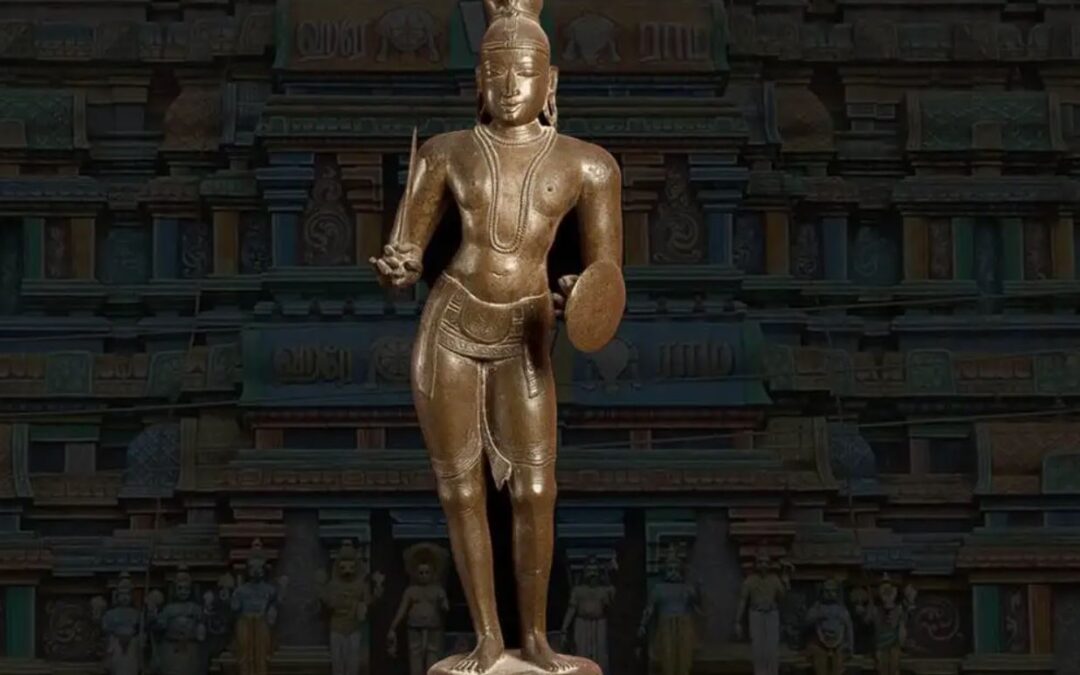
A 16th-century bronze statue of Tirumangai Alvar, originally from a temple in Tamil Nadu, is set to be returned to India from the United Kingdom as part of efforts to repatriate cultural heritage items.
The 57.5-cm statue had been acquired in 1967 by the Ashmolean Museum at the University of Oxford. According to auction house Sotheby’s, the museum purchased it in good faith from private collector Dr J. R. Belmont (1886–1981), although there was no clear record of how the artefact entered his collection.
Questions about the idol’s origins surfaced in November 2019 when a French scholar informed the museum of research showing that a photograph of the same bronze had been taken in 1957 at the Soundarrajaperumal Temple in Thadikombu village. The discovery raised doubts about the statue’s provenance and prompted the museum to launch an internal investigation.
Although no formal claim had been filed at the time, the Ashmolean contacted the High Commission of India in the United Kingdom on December 16, 2019, seeking further information and expressing its willingness to discuss the artefact’s potential return.
Later, on February 11, 2020, a temple executive officer lodged a police complaint stating that the original bronze statue had been replaced by a modern replica. Following this, the Indian High Commissioner formally requested its repatriation on March 3, 2020.
At the request of the Archaeological Survey of India, the museum conducted a metal analysis of the bronze and shared the results to help determine the statue’s provenance.
Xa Sturgis, director of the Ashmolean Museum, said the institution welcomed the return of the artefact. He noted that the museum and the University of Oxford remain committed to ethical collection practices and continued research into the origins and histories of items in their collections.