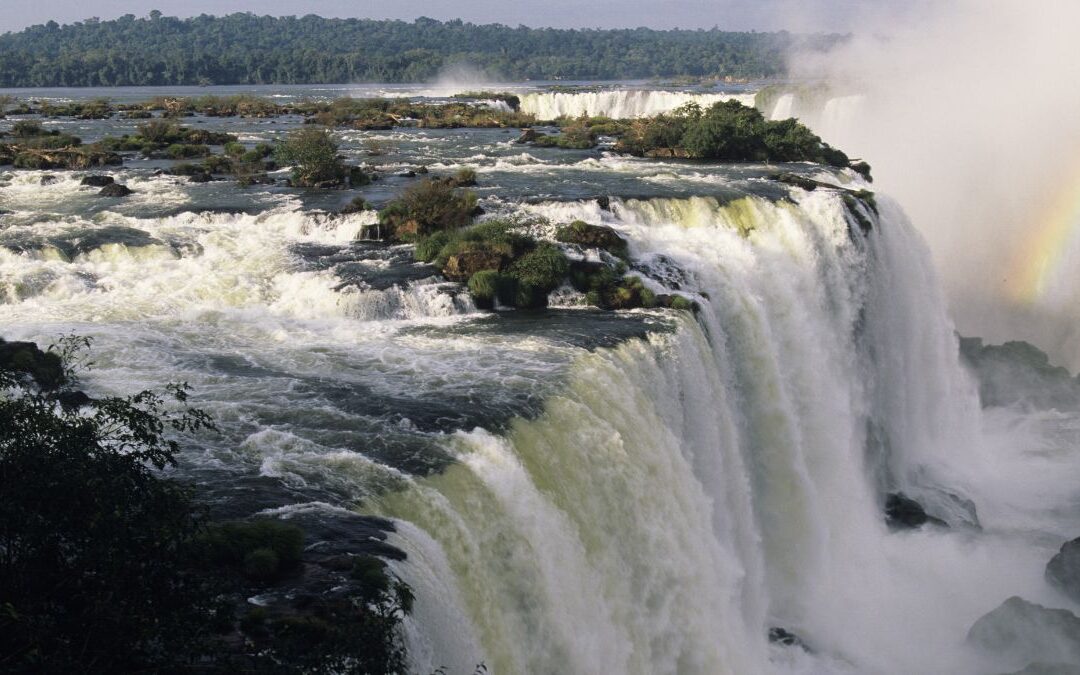
Along the border of Brazil and Argentina, the Iguazu River expands, slows, and then plunges dramatically over a vast basalt plateau. Stretching nearly 2.7 kilometres across, Iguazu Falls is widely regarded as the largest waterfall system in the world by width. Instead of a single drop, the site is composed of around 275 separate cascades, with heights ranging between 60 and 90 metres depending on water levels and seasonal flow.
At the heart of the system lies a sweeping horseshoe-shaped section known as Devil’s Throat. Here, massive volumes of water funnel into a narrow gorge before erupting upward as mist and spray. The plume rising from this central chasm is so dense it can often be seen from aircraft and even satellite imagery. The surrounding landscapes on both sides of the river are protected within national parks, and the falls have held UNESCO World Heritage status since 1984.
A geological formation shaped by lava and erosion
Iguazu Falls sits atop ancient volcanic rock that helped define the modern boundary between Argentina and Brazil. Over thousands of years, the river carved its way through hardened layers of lava, creating stepped formations, islands, and separated curtains of water rather than one continuous cascade.
The Iguazu River bends sharply before reaching the precipice, giving the falls their distinctive wide, curved shape. Some sections descend in delicate strands, while others crash heavily into shadowed channels below. From above, the scale becomes more striking: arcs of white water cut across a dense canopy of deep green forest.
The gorge beneath Devil’s Throat is particularly dramatic. Narrow and steep, it continues to lengthen gradually as upstream erosion reshapes the edge of the plateau. The constant force of water ensures that the landscape remains in slow but steady transformation.
A subtropical forest rich in biodiversity
The falls are surrounded by a vast stretch of protected subtropical rainforest shared by both countries. This ecosystem supports more than 2,000 species of vascular plants, sustained by high humidity created by continuous spray from the cascades.
Wildlife in the region includes tapirs, giant anteaters, howler monkeys, ocelots, jaguars, and caymans. Birdlife thrives near the waterfalls, where moisture and shelter create favourable nesting conditions. One of the most remarkable species found here is the great dusky swift — a fast-flying bird known for building nests behind the waterfalls themselves. These birds dart directly through the falling water to reach rocky ledges hidden from predators. While the behaviour appears dangerous, the protective curtain of water shields them from many forest threats.
Tourism on both sides of the border
Both Argentina and Brazil maintain extensive visitor infrastructure within their respective national parks. Wooden walkways extend across sections of the river, allowing close-up views of several cascades. On the Argentine side, a one-kilometre walkway crosses calm stretches of water before reaching the dramatic edge of Devil’s Throat.
Hotels operate near the entrances on both sides, and access routes are carefully regulated. Despite these controls, visitor numbers remain high throughout the year. Early mornings often reveal the full scale of the spray column rising from the gorge, as sunlight catches the mist. From certain vantage points, the drifting plume casts a faint shadow across the river’s surface before dissolving into the forest air.
Together, the immense scale, dynamic geology and thriving ecosystem make Iguazu Falls not only the world’s widest waterfall system but also one of the most visually and ecologically remarkable natural landscapes on Earth.