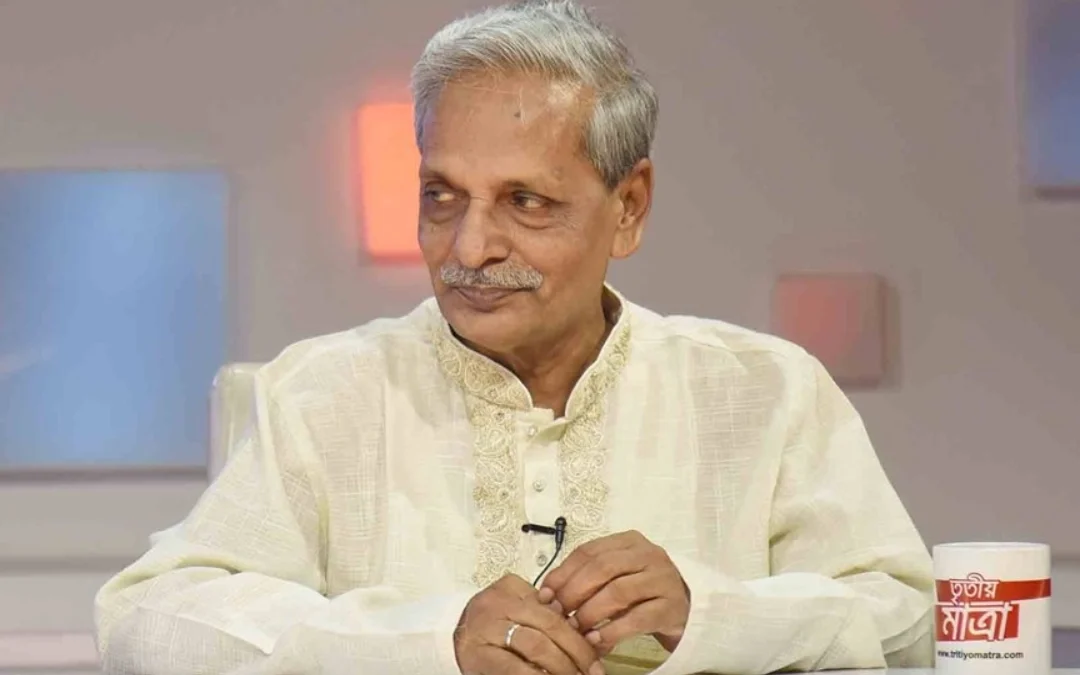
Nitai Roy Chowdhury, 77, the only Hindu minister in Prime Minister Tarique Rahman’s newly formed government and vice-chairman of the Bangladesh Nationalist Party’s (BNP) central committee, has said the administration is committed to protecting minorities and rebuilding friendly relations with India. He also asserted that fundamentalism would not be allowed to take root in Bangladesh.
In an exclusive telephonic interview with TOI after being sworn in as culture minister alongside 48 other cabinet members, including state ministers, Chowdhury emphasised the government’s focus on unity and stability. He was one of only four minority candidates — all from the BNP — to win in the February 12 elections.
Among the 25 newly elected BNP lawmakers inducted into the cabinet with the prime minister, Chowdhury secured victory from the Magura-2 constituency. He polled over 1.4 lakh votes, defeating Bangladesh Jamaat-e-Islami candidate Mustarshid Billah, who received around 1.2 lakh votes.
Reflecting on the state of governance inherited by the new administration, Chowdhury said the previous government led by Sheikh Hasina had left institutions weakened. While stating that the BNP did not wish to dwell on criticism, he said the party’s priority was to move forward with “new hopes and dreams” to place Bangladesh on a path of development.
Elaborating on what he described as institutional damage, Chowdhury alleged that when Hasina left the country in 2024, Bangladesh’s systems were “completely broken.” He claimed the education sector had suffered the most, alleging that under the Awami League it had become policy to pass up to 98% of students in examinations regardless of merit, in order to project higher literacy rates.
He also accused the previous regime of eroding cultural values. During the Awami League’s tenure, he claimed, “obscene dance and music along with hooliganism were encouraged,” while traditional cultural values were sidelined. The new government, he said, would work to restore these pillars while reinforcing the ethos of unity in diversity.
Addressing concerns over the safety of minorities, particularly Hindus, Chowdhury pointed to what he described as a significant turnout of Hindu voters in the recent elections. He said this reflected a shift in political thinking.
“Hindus realised they cannot be treated as a mere vote bank by any party in Bangladesh. They felt they are an inseparable part of this country,” he said.
According to Chowdhury, Prime Minister Rahman and other BNP leaders engaged with Hindu voters ahead of the polls to assure them of safety and equal rights. “They understood they are independent citizens with equal constitutional rights to life and livelihood. That is why they voted in large numbers for the BNP, and we are grateful,” he said.
He added that most political parties now recognise the electoral significance of Hindu voters, noting that their support could influence outcomes in at least 80 of the 297 parliamentary constituencies. While Hindu voters had traditionally backed the Awami League, he said many felt insecure after its leadership left the country, and credited Rahman with rebuilding their confidence.
On relations with India, Chowdhury said the new government sought constructive ties based on “mutual respect, shared interests and understanding.” He stressed the importance of cooperation on internal security matters affecting both nations.
As culture minister, Chowdhury said Bangladesh shares deep cultural ties with at least 48 countries, including India, and vowed to strengthen those bonds. The government, he said, would promote the traditions upheld by previous generations while resisting fundamentalist forces.
“We will all work together for a better Bangladesh,” he said.