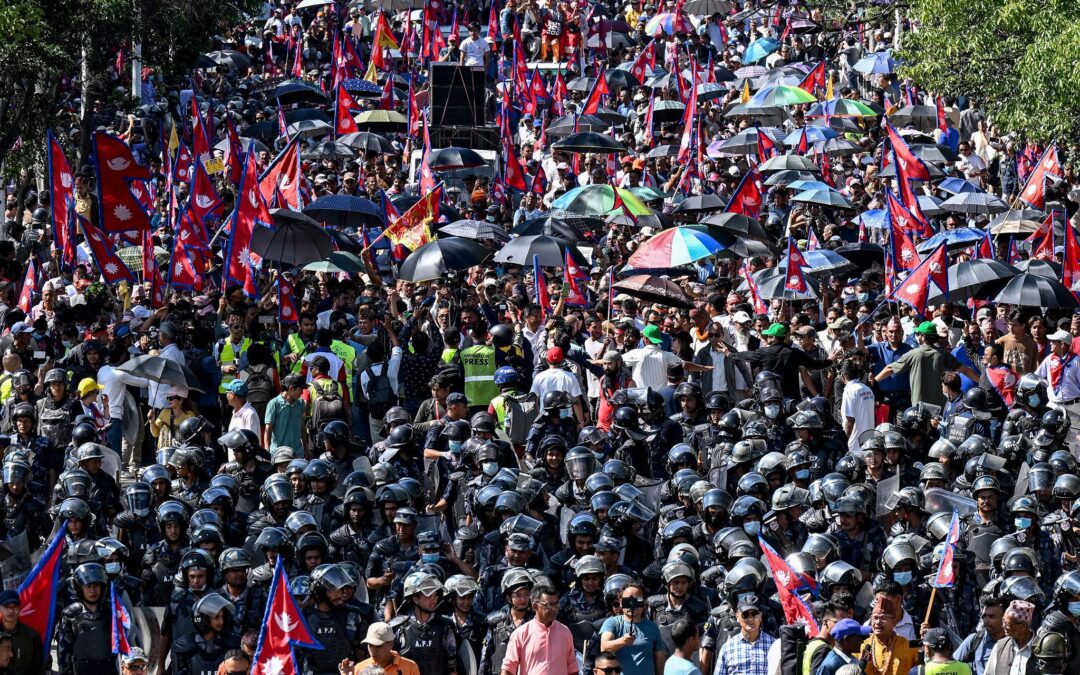
Thousands of supporters of Nepal’s former monarch, Gyanendra Shah, gathered outside Tribhuvan International Airport on Friday, calling for the restoration of the monarchy that was abolished nearly two decades ago.
As Gyanendra returned from a visit to eastern Nepal, he waved to cheering crowds from the sunroof of his vehicle while hundreds of riot police managed the swelling gathering at the airport’s main entrance. Protesters chanted, “Bring back the king” and “Restore constitutional monarchy,” with many lining the route to his private residence in Kathmandu. The demonstrations remained peaceful, and no arrests were reported.
Supporters greeted him with bouquets and waved Nepal’s national flag, shouting slogans such as “King, come and save the country.” Among them was 55-year-old Sanatan Prasad Regmi, who said the monarchy should be restored because the king could serve as a unifying guardian for the nation — a role he believes political leaders have failed to fulfil. “We have no use for a republic,” he said.
Rally despite restrictions
The gathering took place despite prohibitory orders issued by the Kathmandu District Administration Office, which had barred assemblies of more than five people in and around the airport area. Security was tightened across the perimeter to prevent escalation.
Members of the pro-monarchist Rastriya Prajatantra Party, led by senior figure Kamal Thapa, were present, alongside loyalist groups headed by Navaraj Subedi and medical professional Durga Prasai, who had mobilised supporters since early morning.
Why the monarchy debate is back
Nepal formally abolished its 240-year-old monarchy in 2008 after mass protests in 2006 forced Gyanendra to relinquish direct rule. Parliament subsequently voted to end the institution, and the former king vacated the Royal Palace to live as a private citizen in Kathmandu.
However, economic hardship and persistent political instability have revived royalist sentiment. Nepal has witnessed 14 government changes in the past 18 years, contributing to policy uncertainty, investor unease and sluggish economic growth. Many citizens have voiced frustration with the republican system, arguing it has not delivered on promises of development, employment and good governance.
Political churn ahead of polls
The renewed pro-monarchy demonstrations come amid broader political turbulence. In September, youth-led protests — dubbed the “Gen Z revolution” — erupted over corruption, lack of accountability and a controversial government ban on social media. The unrest culminated in the resignation of Prime Minister KP Sharma Oli.
Following his exit, Sushila Karki was sworn in as interim Prime Minister. The 73-year-old is set to remain in office until early March, when elections will be held to choose a new executive leadership.
Parliamentary elections are scheduled for March 5, with 65 parties contesting 275 seats in the federal assembly. Of Nepal’s 30 million people, nearly 19 million are eligible to vote — including close to one million first-time voters, many of them young citizens energised by recent protests.
Pro-Gyanendra groups, which secured around 5% of seats in the previous election, are aiming to expand their presence. During a press briefing in Kathmandu, Durga Prasai said royalists hope to restore the monarchy before the general election and insisted that the issue must be addressed.
Despite the visible enthusiasm among supporters, analysts say Gyanendra’s immediate return to power appears unlikely, as the majority of mainstream political parties remain opposed to reinstating the monarchy.