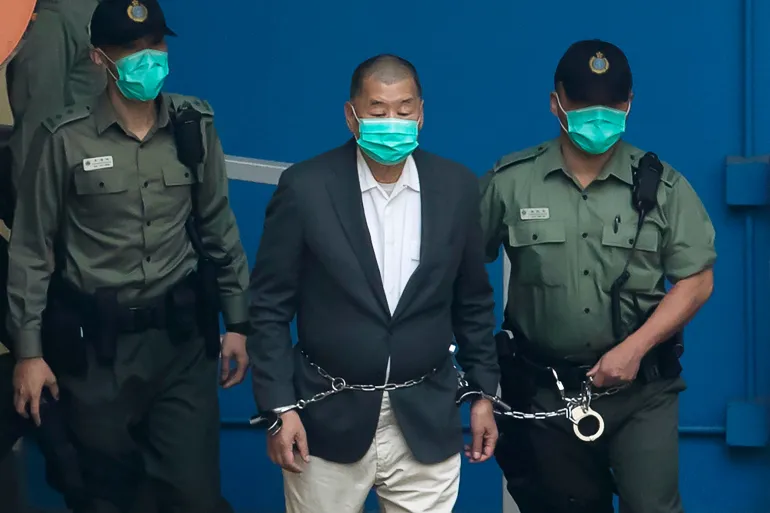
Hong Kong pro-democracy media figure Jimmy Lai, a British citizen, has been sentenced to 20 years in prison in a national security case, more than five years after his arrest in August 2020. The verdict has triggered widespread international condemnation, with critics calling it a “death sentence.”
Lai, 78, was found guilty of “colluding with foreign forces to endanger national security” under China’s National Security Law. He has remained in custody since 2020 and had already been serving time for earlier convictions.
The punishment is the harshest imposed so far under the law, surpassing the previous record of 10 years given in 2024 to legal scholar Benny Tai.
How the Sentence Was Determined
Lai, founder of the now-defunct Apple Daily newspaper, was convicted on two counts of conspiring to collude with foreign forces—an offence that can carry sentences ranging from 10 years to life in serious cases.
He was also found guilty under a separate colonial-era sedition law for conspiring to publish “seditious” material, which carries a maximum sentence of two years for first-time offenders.
Judges have the discretion to decide whether sentences run concurrently or consecutively. In Lai’s case, the court imposed a total term of 20 years after, in its words, “taking a global view” of his “serious and grave criminal conduct.”
Two years of the sentence will overlap with an existing term of five years and nine months that Lai is already serving following a 2022 fraud conviction linked to a contractual dispute. This means he is expected to serve about 18 more years in prison.
His lawyer said Lai has 28 days to file an appeal, though no decision has yet been announced. Under amendments introduced in 2024, early release for prisoners convicted under national security provisions has become increasingly difficult.
‘Death Sentence’ Criticism
If Lai serves his full term, he would be in his mid-90s upon release, prompting supporters to describe the punishment as a “de facto death sentence.”
Hong Kong Chief Executive John Lee welcomed the ruling, calling it “deeply gratifying.” In an official statement, he said Lai’s crimes were “heinous and evil in the extreme” and that the sentence demonstrated the rule of law.
Beijing also defended the verdict. Foreign Ministry spokesperson Lin Jian said the sentence was “legitimate, reasonable, and legal,” adding that “there is no room for argument.”
International Condemnation
The ruling drew sharp criticism from Western governments and rights groups. UK Foreign Secretary Yvette Cooper described the case as “a politically motivated prosecution,” saying the National Security Law was designed to “silence critics.”
She said Prime Minister Keir Starmer had raised Lai’s case directly with Chinese President Xi Jinping during a recent visit to Beijing, and that Britain would continue to press for his release.
Cooper also referred to the Sino-British Joint Declaration, which governs Hong Kong’s status following its handover to China in 1997, arguing that the spirit of the agreement has been undermined.
A Symbol of Press Freedom Concerns
Lai’s conviction is widely seen as emblematic of the shrinking space for dissent and independent journalism in Hong Kong since the introduction of the National Security Law in 2020.
Supporters say his case reflects a broader crackdown on opposition voices, while authorities maintain that the law is necessary to safeguard stability and sovereignty.
With the longest sentence yet imposed under the legislation, Lai’s fate has become a powerful symbol in the global debate over Hong Kong’s freedoms and China’s growing influence over the territory’s legal system.