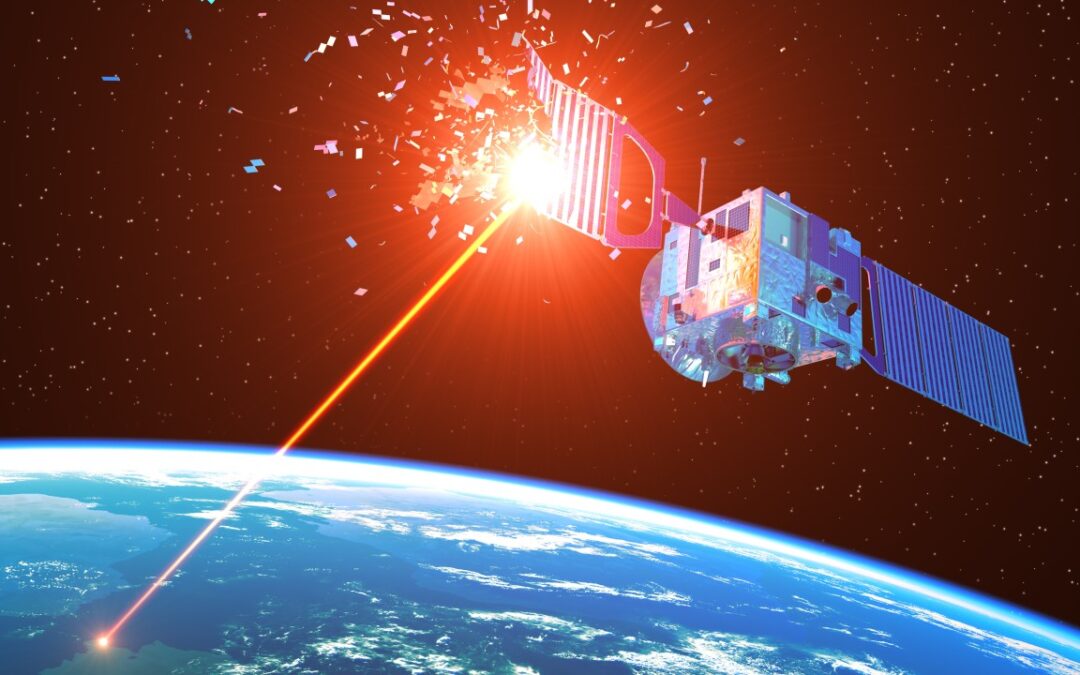
Chinese researchers have developed a compact high-power microwave system that could pose a significant challenge to satellite networks such as Starlink, according to recent reports.
The device, known as TPG1000Cs, was developed at the Northwest Institute of Nuclear Technology in Xi’an. It is capable of delivering up to 20 gigawatts of power for as long as one minute, making it one of the most powerful systems of its kind.
China has repeatedly expressed concerns that Starlink, operated by SpaceX, poses risks to its national security. Researchers are now reportedly working on so-called “Starlink killer” technologies, including high-power microwave weapons and laser systems, to counter large constellations of low-Earth-orbit satellites.
According to the South China Morning Post, these systems are being developed to disrupt or disable satellite networks during potential conflicts.
Increased Vulnerability of Low-Orbit Satellites
While SpaceX has lowered the orbits of Starlink satellites to reduce collision risks, analysts note that this move has also made them more vulnerable to ground-based directed-energy attacks, including microwave and laser weapons.
Lower-altitude satellites are easier to target and track, potentially exposing them to emerging counter-space technologies.
Key Features of the TPG1000Cs
Measuring about four metres in length and weighing roughly five tonnes, the TPG1000Cs is compact enough to be mounted on trucks, warships, aircraft, or even satellites.
If deployed in space, the system could become even more difficult to detect and counter. Researchers say it is capable of delivering up to 3,000 high-energy pulses in a single session—far exceeding many comparable systems.
Developers have introduced several design innovations to improve performance and efficiency:
- High-strength steel components were replaced with aluminium alloy, reducing overall weight by nearly one-third.
- Wavy grooves were etched into insulating plates to lengthen surface paths and prevent electrical discharges, similar to winding roads that prevent current from “cutting corners.”
- A dual U-shaped energy-storage structure replaced traditional straight tubes, allowing energy to bounce back and forth and achieve the same output in roughly half the space.
- Insulating oil was upgraded, enabling the system to store significantly more energy.
These changes have allowed the device to deliver high output while remaining relatively compact and mobile.
Research Publication and Development Team
The technical advances were detailed in a paper published on December 30 in High Power Laser and Particle Beams, a peer-reviewed Chinese journal.
The study was led by Wang Gang of the Key Laboratory on Science and Technology on High Power Microwave at the Northwest Institute of Nuclear Technology.
Growing Focus on Counter-Space Capabilities
Experts say the development of systems like the TPG1000Cs reflects China’s growing focus on counter-space technologies designed to disrupt satellite-based communications, navigation, and surveillance.
As satellite constellations expand rapidly around the world, directed-energy weapons are increasingly seen as a potential tool in future conflicts, raising concerns about the security and sustainability of space-based infrastructure.