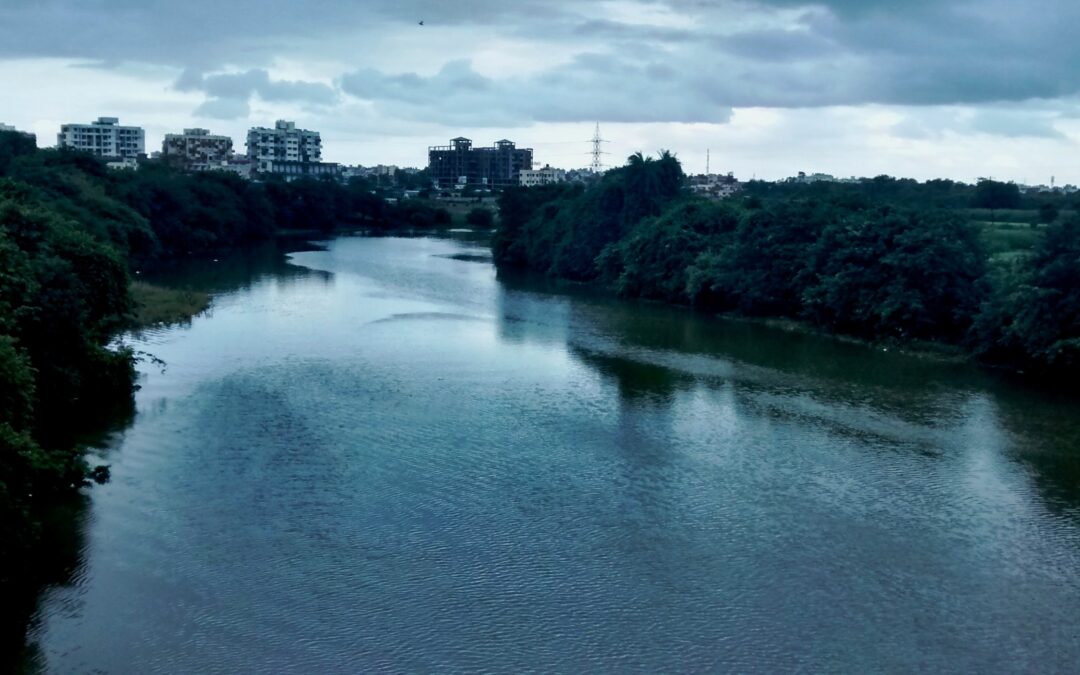
Pune: The worsening condition of rivers flowing through Pune and Pimpri Chinchwad has repeatedly drawn scrutiny in recent years. Citizens, activists and experts point to a common cause: the failure of sewage treatment plants (STPs) to function efficiently—both at the municipal level and within residential complexes.
A Bombay high court order issued on January 19, following a public interest litigation (PIL), has now directed municipal corporations across Maharashtra to deny occupancy certificates (OCs) to high-rise buildings that are either not connected to civic sewage networks or lack an on-site STP. The ruling is particularly significant for Pune, where rapid redevelopment has led to a surge in new housing societies and growing pressure on basic resources such as clean water.
Public health concerns underscore the urgency. Last year’s Guillain-Barré Syndrome (GBS) outbreak in Pune—linked to wastewater contamination of drinking supplies—highlighted the dangers of inadequate sewage management and the potential for serious health emergencies.
Health risks loom large
In February 2024, residents of Blue Ridge township in Hinjewadi, home to around 20,000 people, were alarmed to find bloodworms (chironomid larvae) in their drinking water. The township draws water directly from the Mula river, which is polluted by untreated sewage discharged upstream.
“When we complained to the Maharashtra Pollution Control Board (MPCB) and MIDC, officials found that untreated sewage was being dumped directly into the river,” said Vijay Patil, a former committee member of the township. “The pipe discharging sewage was shifted away from our intake point, which resolved the immediate issue—but that was not the only source of pollution.”
Patil said multiple small settlements and labour camps upstream lack proper sewage outlets, while agricultural runoff further contaminates the river. “We are strict about our STP compliance because we know the consequences of releasing untreated sewage into waterbodies,” he added.
Excess treated water from Blue Ridge’s STP is used to irrigate the township’s golf course. Residents have also approached PMRDA and MIDC, seeking an alternative drinking water source due to concerns over long-term exposure to contaminated water.
Groundwater contamination widespread
Untreated effluents polluting groundwater and disconnected sewage networks remain common across the city. The MPCB operates 294 water quality monitoring stations statewide. Its 2023–24 report revealed troubling results from six groundwater stations in Pune: only two showed ‘good’ water quality, one was classified as ‘poor’, and three were deemed ‘unsuitable for drinking’.
At Casa Imperia Phase 1 in Wakad, society chairman Nitin Selute said sewage from upstream areas has contaminated the society’s only well. “A nullah beside our society, once a natural stream, began leaking sewage into the well. The water was so dirty that even our STP couldn’t handle it,” he said.
The society has since stopped using the well and now depends entirely on water tankers, spending Rs24–26 lakh annually on water for 160 flats—nearly half of its yearly budget. “We live in constant fear of falling sick,” Selute said, adding that civic authorities must ensure clean water sources when approving large-scale development.
Despite the crisis, the society’s 100 KLD STP is fully functional, with 100% reuse of treated water for flushing and no discharge outside the premises. The STP is inspected monthly by PCMC. Residents are also working with Mission Groundwater, a city-based sustainability initiative, and plan to petition authorities to revive the adjacent stream.
STPs exist, but many lie defunct
Mission Groundwater founder Ravindra Sinha estimates that Pune and Pimpri Chinchwad together have around 1,000 private STPs in residential and commercial buildings. “Most are functional, which is encouraging, but a significant volume of treated water is still discharged into drainage lines, streams or rivers,” he said.
According to Sinha, defunct STPs remain a major issue due to a lack of regular inspections and penalties. “The cost of operating an STP deters many societies, though concessional electricity tariffs from MSEDCL are available for STPs and water treatment plants,” he noted.
Awareness gap and misinformation
Pradeep Pawar, a chemical engineer who runs a wastewater treatment firm in Wakad, said lack of awareness is the biggest challenge. “Some societies cut corners due to operating costs or hire untrained personnel to manage STPs, which eventually leads to higher expenses and environmental damage,” he said.
He added that STP capacity and costs depend on population size, and surplus treated water often has to be released into drainage lines when reuse options are limited. “Solving the problem requires coordination between government agencies, civic bodies and residents,” Pawar said.
What officials say
PMC chief engineer (drainage) Jagdish Khanore said that under UDCPR 2020, societies with over 100 flats must treat and reuse grey water. “While nearly 80% of societies within PMC limits have functional STPs, many are not being used. We are exploring real-time monitoring through software solutions,” he said, adding that peripheral areas still lack sewage infrastructure, for which a master plan is in place.
PCMC chief engineer Sanjay Kulkarni said notices have been issued to 84 societies for non-operational STPs. “We conduct regular inspections and can disconnect water supply if violations persist,” he said, noting that the city plans to expand its drainage network by 285km.
Legal scrutiny intensifies
Following the 2025 GBS outbreak, a petition filed before the National Green Tribunal highlighted unsafe contamination in water samples across Pune and Pimpri Chinchwad, with coliforms and E. coli detected. Petitioner Pushkar Kulkarni called for an overhaul of sewage infrastructure to protect citizens’ right to safe drinking water.
Environment lawyer Maitreya Ghorpade said STPs are mandatory under MPCB norms and UDCPR 2020, and non-compliance can lead to prosecution. “After the Bombay HC’s January 2026 order, no OC can be granted without a functional STP,” he said, adding that punitive action has already begun against repeat violators.
Running an STP can be affordable
Hinjewadi Hills Phase 2 committee member Narayan Wadekar said his society halved its electricity bill after switching to MSEDCL’s concessional tariff for STPs and WTPs. “Our monthly bill dropped from Rs6.5 lakh to Rs3.2 lakh,” he said, stressing that proper awareness and compliance can significantly reduce costs.