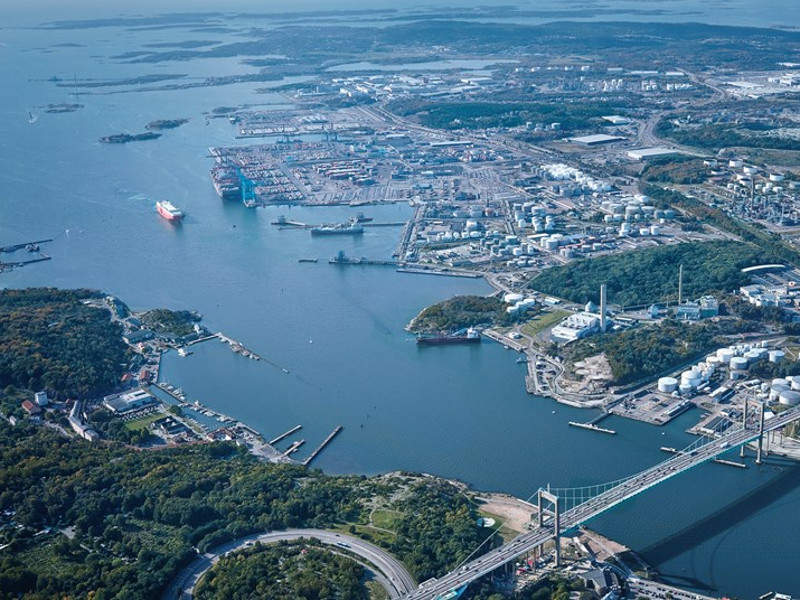
A growing range of shipping services, congestion at Europe’s ports, and an efficient rail connection between the port and the rest of Sweden. These are key reasons why 2025 became a new record year for the Port of Gothenburg, with 934,000 handled TEU:s*. This represents growth of 4 per cent compared with the previous year and is also the highest full-year volume ever recorded in the port’s history.
“Record volumes are proof that the port has become even more attractive as a logistics hub. We see several drivers behind this growth: the port’s range of deep-sea services has expanded significantly with two new direct services to Asia. The port’s rail system, Railport Scandinavia, is a stable and unique global network that continues to grow, providing efficient access to the port for all of Sweden,” says Claes Sundmark, Vice President Sales & Marketing at the Port of Gothenburg, and adds:
“On top of that, other major ports in Europe have struggled with capacity challenges during the year, while the Port of Gothenburg’s terminal operators have been able to handle both existing and additional volumes.”
Container volumes at the Port of Gothenburg are also growing considerably faster than in Sweden’s other ports combined.
Rail volumes continue to grow – over 60 per cent of container cargo transported by rail
The Port of Gothenburg’s ambition is for as large a share as possible of cargo to and from the port to be transported by rail. In 2025, container cargo transported by rail increased by 5 per cent to 529,000 TEU – also a new all-time high. The share of containers transported by rail is now just over 60 per cent.
“Rail growth is primarily driven by increased volumes on the rail shuttles to and from terminals in the Stockholm region and northern Sweden, as well many hinterland regions. Swedish industry as a whole benefits from the Port of Gothenburg’s broad range of services,” says Claes Sundmark.
RoRo and vehicles
The Port of Gothenburg’s intra-European RoRo traffic consists of rolling cargo units loaded onto vessels with frequent departures to strategically important freight hubs in Northern and Central Europe, as well as the United Kingdom. In 2025, 525,000 units were handled, a marginal increase compared with the previous year.
The Port of Gothenburg is also the largest vehicle port in the Nordic region and handled 251,000 vehicles during the year. After three quarters, volumes were down 9 per cent compared with the same period the year before, but following a strong recovery in the fourth quarter, the decline for the full year amounted to 2 per cent.
Energy products
The Port of Gothenburg is Sweden’s largest public energy port and is pivotal for the country’s energy supply. In 2025, 20,7 million tonnes of energy products were handled at the port. During the first half of the year, volumes decreased by 13 per cent compared with the same period the previous year, partly due to planned maintenance shutdowns. However, the energy segment also saw a recovery during the autumn, resulting in a full-year decline of 5 per cent.
Passenger volumes and cruise calls
In total, 1,4 million passengers travelled to and from Gothenburg in 2025, an increase of 1 per cent compared with 2024. The number of cruise calls increased by 13 per cent to 63 calls during the same period.
Background: Container handling at the Port of Gothenburg over the years
When containerisation began to transform global trade in the 1960s, the Port of Gothenburg faced a decisive crossroads.
Skandiahamnen, which opened in 1966 after many years of planning, became the arena for a strategic major investment. At the time, the container was still a newer concept, and it was far from certain that it would gain widespread adoption. Nevertheless, the Port of Gothenburg chose to invest heavily in container handling – a decision that provided an early advantage and a volume growth that over time has cemented the port’s role as the largest port in Scandinavia.
Source: Port of Gothenburg