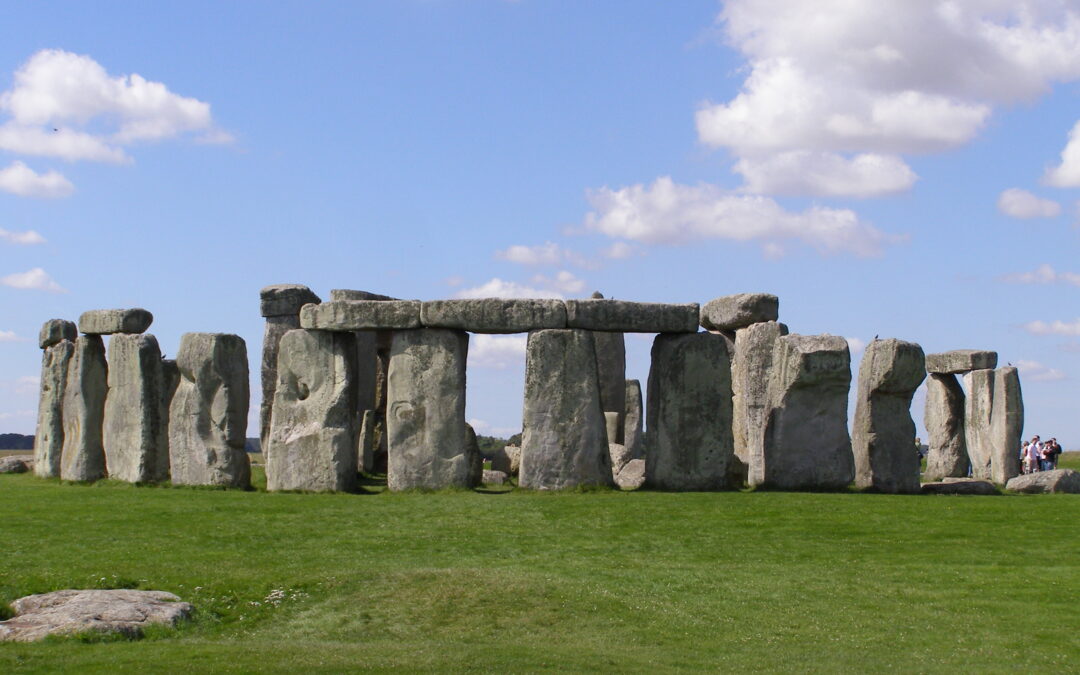
Stonehenge stands on the open chalk landscape of southern England—familiar, iconic, yet still deeply puzzling. For decades, one practical question has lingered: how did stones weighing many tonnes arrive here long before wheels, metal tools or written plans existed?
A new study led by geologists at Curtin University shifts the answer onto firmer scientific ground. By analysing microscopic mineral grains in local river sediments, researchers tested the long-debated idea that glaciers may have carried the stones south during the Ice Age. Their conclusion: the evidence points away from ice—and toward human effort.
The landscape around Salisbury Plain shows no chemical signature of glacial transport. Instead, the sediments reflect materials recycled locally over time. This strengthens the growing view that Neolithic communities deliberately moved the stones themselves, often over vast distances.
What the research found
The study, titled “Detrital zircon–apatite fingerprinting challenges glacial transport of Stonehenge’s megaliths”, focuses on tiny mineral grains—mainly zircon and apatite—found in streams draining the Salisbury Plain. These minerals act like geological fingerprints, preserving information about where sediments originally came from.
If glaciers had crossed this region, they would likely have left behind mineral signatures from Wales or northern Britain. That signal is missing. Instead, the mineral ages match rocks already known from southern England, suggesting the sediment has been locally recycled rather than deposited by ice.
This matters because glacial transport has often been used as a convenient explanation: if ice had dragged the stones close to the site, the human effort involved would have been far smaller. The new evidence makes that argument increasingly difficult to support.
No sign that glaciers reached Salisbury Plain
The findings also reinforce a broader consensus among geomorphologists. There is little physical evidence that glaciers ever reached Salisbury Plain during the Pleistocene period. There are no clear moraines, no consistent trails of glacial debris, and no buried layers of glacial till.
While fine sediments can travel long distances through meltwater, massive stones usually do not. The absence of glacial fingerprints in surrounding deposits makes it highly unlikely that multi-tonne blocks arrived by chance.
The sarsens: local, but still a monumental task
Not all of Stonehenge’s stones came from far away. The largest stones—the sarsens—were sourced from West Woods, roughly 25 kilometres north of the monument. That distance may seem modest, but each stone weighs about 25 tonnes. Moving them would still have required sophisticated planning, coordination and labour.
Although the new mineral analysis does not directly examine the sarsens, it supports a wider conclusion: the materials used at Stonehenge were not random. They were carefully selected and deliberately transported.
Bluestones: unmistakable evidence of human organisation
The smaller bluestones tell an even clearer story. Their geological signatures match outcrops in the Preseli Hills of west Wales—around 230 kilometres from Stonehenge. Some stones may have travelled part of the journey by sea, others overland. Either way, such distances rule out accidental movement.
One stone is more extraordinary still. The Altar Stone appears to originate from the Orcadian Basin in northeast Scotland. If confirmed, that implies a journey of more than 700 kilometres. No known glacial pathway can explain such movement. Human organisation can.
What this changes—and what it doesn’t
The study does not explain exactly how the stones were transported. Sledges, rollers and boats remain plausible methods. What it does change is the balance of probability.
Stonehenge now looks less like a monument shaped by chance geological processes and more like one created through sustained human intention, effort and ingenuity. The mystery is not fully solved—but the space for easy answers has narrowed. The stones are there because people brought them.