NEW DELHI: The recent drowning of a tech professional in Noida has once again turned the spotlight on urban emergency preparedness in the capital. Delhi’s aquatic rescue system operates through a layered response network — ranging from high-tech specialised units of the National Disaster Response Force (NDRF) to the rugged, on-ground divers of a government boat club — and faces unrelenting pressure every day.
At the foundation of this system are quick-response units stationed across multiple districts of Delhi, with two more currently in the pipeline. These units are connected to emergency operation centres that function round the clock, all year long.
“As soon as the emergency operation centre receives a distress call, the information is verified and details are gathered immediately. Fire services, police, ambulances and Centralised Accident and Trauma Services are alerted without delay. The chairperson of the concerned district disaster management authority and other senior officials are also informed,” a government official explained. A search-and-rescue team is then deployed, while other disaster management centres are simultaneously put on alert and the situation is continuously monitored.
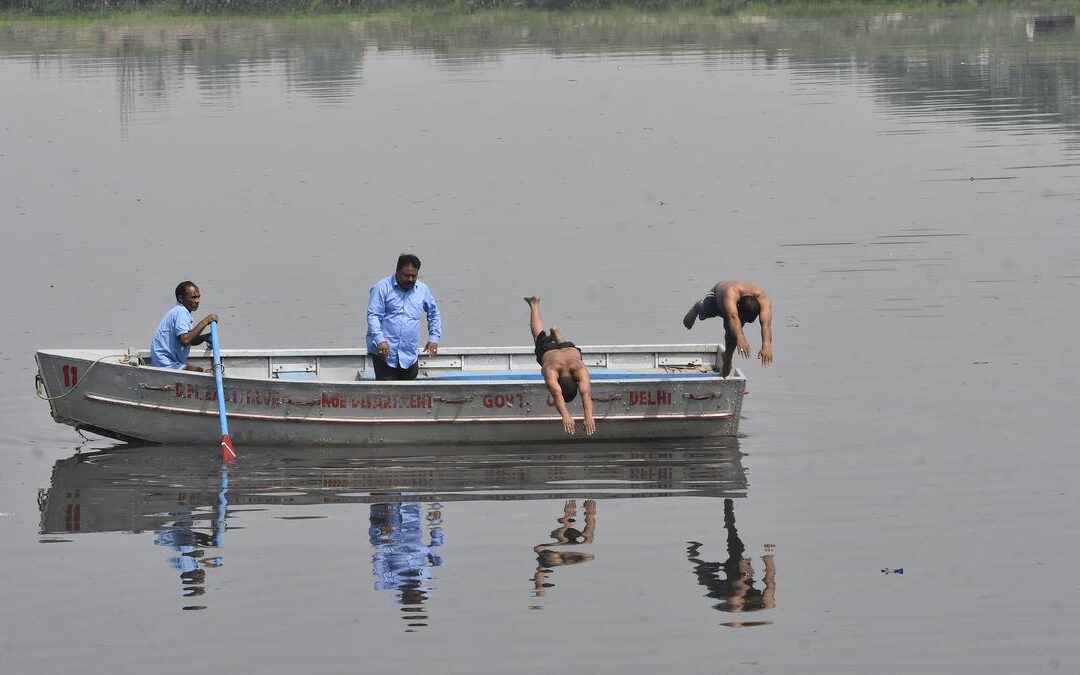
Yet, beyond command rooms and the NDRF’s Dwarka hub, the real backbone of Delhi’s aquatic rescue operations is often a little-known 15-member team of divers based at a Delhi government boat club in Civil Lines. Functioning under the office of the district magistrate (east), the team received, on average, one call a day last year. Many SOS calls received by the emergency operation centre are also redirected to this unit.
This compact team covers nearly the entire capital — from the 45-km stretch of the Yamuna to Najafgarh drain, Bhalswa Lake, Model Town Lake, Asola Bhatti mines, Jaitpur, Kondli and the Munak Canal belt. According to data maintained by the club, the unit handled 348 drowning-related calls last year. Of these, 61 resulted in successful rescues, 110 involved the recovery of bodies, and in 34 cases, bodies could not be located despite extensive search efforts. The team also had to contend with 106 fake or repeat calls, which significantly drained time and resources.
Water-related emergencies peak during the monsoon. September was the busiest month, with 84 calls, 21 rescues and 21 body recoveries. August saw 39 calls, October 36, and July 30 — resulting in seven rescues and 10 recoveries. However, May proved the deadliest month: of the 35 calls received, 23 ended in body recoveries, with only one person rescued.
The conditions in which these divers operate are stark. They work without oxygen cylinders or protective suits, wearing only undergarments, which they believe allow greater underwater mobility. Often, they enter toxic, debris-filled waters with their eyes closed to avoid irritation, navigating by touch — tracing canal walls, bridge pillars or drain edges. They routinely face suction currents, chemical foam, snake bites and cuts from sharp objects such as glass shards and exposed wires.
Harish, who heads the boat club, said the team is frequently deployed to deep pits, flooded construction sites, abandoned basements and waterlogged buildings — places where people either fall accidentally or, in some tragic cases, jump in. These sites typically lack safe access points, lighting or protective barriers, compounding the danger. Armed with ropes and torches, the divers descend into narrow, unstable spaces filled with sludge and construction debris. Despite poor visibility, risks of cave-ins and entanglement in reinforcement rods or scaffolding, they continue operations until a victim is rescued or a body recovered.
Officials explained that during most rescue operations in Delhi, the police act as first responders. The District Disaster Management Authority forms the second layer of response, while the NDRF is deployed when situations escalate.
The NDRF’s 16th battalion in Dwarka maintains 18 specialised teams equipped with advanced technology. For aquatic operations, their inventory includes fibre-reinforced plastic boats, inflatable rescue boats, rubber boats, diving kits, flow meters, high-pressure breathing air compressors, life jackets, underwater communication devices, underwater cameras and wind meters. Personnel undergo rigorous training in aquatic disaster response, enabling them to operate in rising water levels, heavy rainfall and chaotic environments, while also providing pre-hospital medical care.
“At any incident site, our personnel first assess the situation, identify access routes to the disaster zone, and allocate tasks to ensure coordinated and efficient operations,” an official said.
Together, these layers — from command centres and elite forces to barefoot divers risking their lives in toxic waters — form the fragile yet determined safety net that keeps Delhi’s aquatic rescue system afloat.