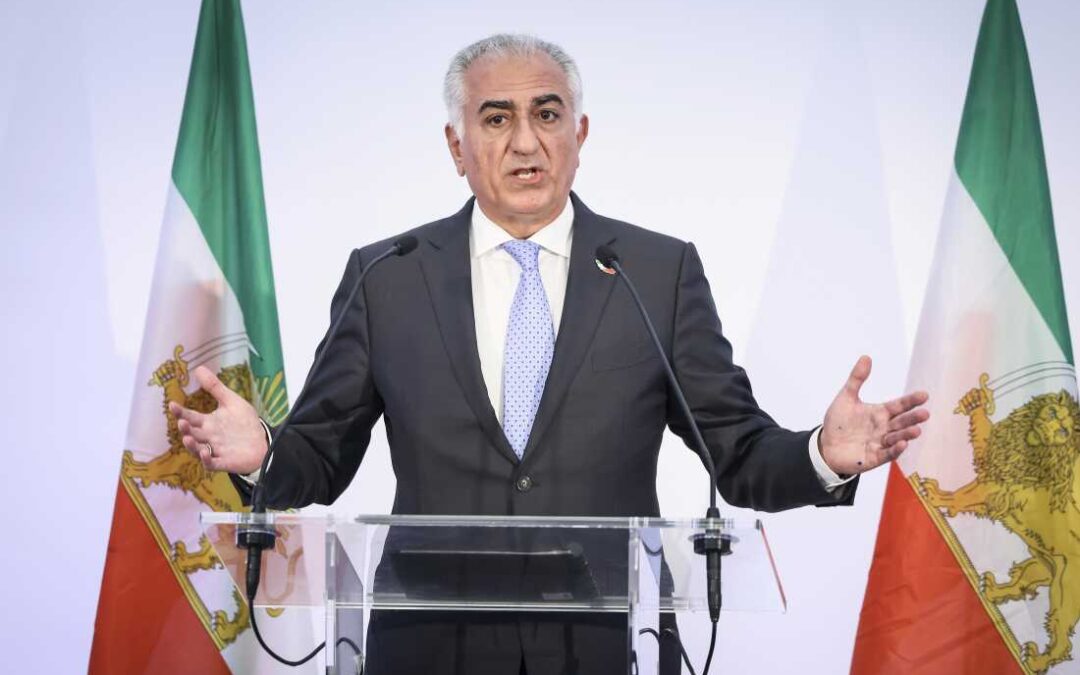
US President Donald Trump has described Iranian opposition figure Reza Pahlavi as a “very nice” person but voiced uncertainty over whether the former crown prince, living in exile, could unite enough domestic support to assume leadership in Iran. His comments come as nationwide protests against Iran’s clerical regime continue to intensify.
In an exclusive interview with Reuters at the Oval Office, Trump suggested that the ongoing unrest could potentially weaken or even topple Iran’s current leadership. However, he stopped short of endorsing Pahlavi as an alternative. “He seems very nice, but I don’t know how he’d play within his own country. And we really aren’t up to that point yet,” Trump said.
While Trump has repeatedly warned that the United States could consider intervention in support of Iranian protesters, he has also signaled caution about backing any single opposition leader. He added that he would not object if Iranians themselves accepted Pahlavi’s leadership, but questioned whether such support actually exists. “I don’t know whether or not his country would accept his leadership, and certainly if they would, that would be fine with me,” he remarked.
Iran has been gripped by widespread protests that initially erupted over economic hardships but have since evolved into broader demands for political reform and an end to the theocratic system. Demonstrations have spread to multiple cities despite heavy security deployments, internet restrictions, and mass arrests. Reports suggest that thousands have been killed in the government’s crackdown.
Trump acknowledged the possibility that the government in Tehran could fall but cautioned that political outcomes are inherently unpredictable. “Whether or not it falls, it’s going to be an interesting period of time,” he said, adding that “any regime can fail.”
Reza Pahlavi, the son of Iran’s last shah, Mohammad Reza Pahlavi, has emerged as a prominent voice during the current wave of protests. Overthrown during the 1979 Islamic Revolution, the Pahlavi family has lived in exile for decades. Now 65, Reza Pahlavi has used the moment to urge Iranians to maintain pressure on the regime, arguing that sustained protests could bring about its collapse.
In recent video messages and social media posts, Pahlavi said he is preparing to return to Iran after nearly five decades in exile. “I too am preparing to return to the homeland so that at the time of our national revolution’s victory, I can be beside you, the great nation of Iran. I believe that day is very near,” he wrote.
He has also claimed that the opposition has developed a roadmap for a post-regime transition, including a “100-day plan” aimed at establishing a democratic government and preventing instability. “Do not abandon the streets. My heart is with you… We will take back Iran,” he said in a message reported by ANI.
Born in Tehran in 1960, Reza Pahlavi was named crown prince in 1967. He left Iran in 1978, shortly before the revolution, to undergo jet fighter training in the United States and later studied political science at the University of Southern California. After his father’s death in 1980, he declared himself shah in exile, later telling The Washington Post in 1989, “In a way, I’m king-elect.”
Despite his royal lineage, Pahlavi has insisted that he does not seek the restoration of the monarchy. Instead, he presents himself as an advocate for a secular, democratic Iran achieved through non-violent civil disobedience and a national referendum, describing his role as a “catalyst” for change rather than a ruler in waiting.