Did you know that many of the stones in Bruges come from faraway places? They were brought along as ballast to keep ships stable at sea. Today, software, ballast tanks, and tables ensure that balance, but the principle remains the same.
Floating is not the same as being stable
A ship will float as long as it weighs less than the amount of water it displaces. That is Archimedes’ principle. But floating is one thing; remaining stable is another.
A light ship sits high in the water and has a high centre of gravity. This makes it more sensitive to wind and waves. A heavier ship sits deeper and is more stable, because its centre of gravity is lower. If a ship is too light, the crew will add ballast: extra weight to make the vessel more stable in the water.
From boulders to sherry barrels
Stones as ballast
During the Hanseatic Period, roughly 1350 to 1450, ships often carried light goods such as stockfish or silk. They were too light to keep the ship steady, so skippers brought heavy stones aboard. Typically, they used basalt, granite, or limestone from Scandinavia or England.
Once in Flanders, the stones were unloaded or thrown overboard. The stones were later used by locals for streets, dykes, and church towers. That explains why medieval ballast stones continue to show up today in Bruges, Damme, and Hoeke.
Alcoholic beverages as ballast
Between the 16th and 19th centuries, ships often used fortified wines such as port, sherry, or madeira as liquid ballast. These were heavy, heat-resistant, and had a long shelf life. Ideal, therefore: serving both as ballast and as cargo.
Water as ballast
The advent of steamships and steel hulls in the 19th century saw stones and wine barrels disappear. Built-in tanks made it possible to pump in or discharge seawater depending on the cargo.
Today, every large ship has ballast tanks at the bottom of the hull. Pumps precisely control how much water is in them. This ballast water, though, caused a new problem, transporting micro-organisms and exotic species from one harbour to another. They can disrupt local ecosystems.
That is the reason ships need to treat their ballast water before releasing it. This is usually done through:
- UV treatment: the water is disinfected using UV light;
- Chemical treatment: a disinfectant is added, similar to chlorine.
During discharge, the disinfectant is neutralised to prevent harmful chemicals from entering the sea. This way, they kill the organisms without causing lasting harm to the environment. While this might seem extreme, the alternative of invasive species upsetting ecosystems is far worse.
Balance is more than just ballast
Ballast is only one part of the story. True stability comes from well-considered cargo distribution. Cargo planners and stability officers calculate down to the tonne where each piece of cargo should be placed.
Bulk carriers
Ships transporting steel, ore, or grain load their cargo fully at the bottom. This creates a low centre of gravity, and therefore a great deal of stability. However, it also makes the ship “stiff”, causing it to roll quickly from port to starboard. Not dangerous, but certainly unpleasant for the crew.
To limit that:
- they fill the ballast tanks, particularly when the ship is empty or only partially loaded;
- they carefully distribute the weight across the five or six holds of the bulk carrier;
- they use hydrostatic tables, a set of pre-calculated values showing how a ship behaves at different drafts and how much weight can be safely carried on board;
- they take the type of cargo into account.
Steel remains stable because it is firmly secured with wooden beams, but grain cannot be fixed in place. If a hold is not full, the grain can shift with every wave. This can cause the ship to list or even capsize. That is why the Grain Code requires grain to be covered or divided with partitions to prevent it from moving.
Container ships
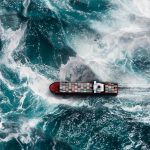
With container ships, the calculations are more complex. A stowage plan determines exactly where each container is placed. Heavy containers are placed at the bottom and in the centre, lighter ones on top. Perfect balance between port and starboard is essential to prevent the ship from listing. Each container also has a maximum stack weight: the total weight that may be placed on top.
Modern ships use software to calculate and visualise all of this for each hold or bay. Large shipping companies have their own vessel planners who coordinate the entire voyage. Their calculations are crucial for a ship’s stability.
In summary
Ships remain balanced thanks to a combination of ballast and accurate cargo distribution. Stability at sea is no accident; it is the result of human effort. It requires calculations, monitoring, and constant adjustment.
Source: Port of Antwerp-Bruges