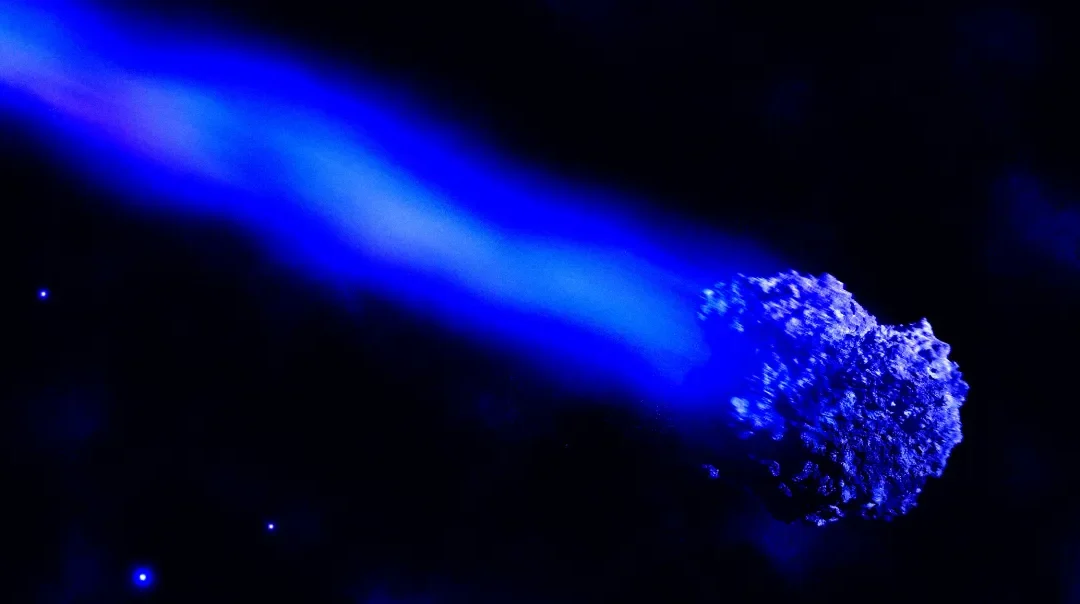
Since it was first detected in July, interstellar object 3I/ATLAS has captivated astronomers and fuelled debate. Only the third known visitor from beyond our Solar System, it has defied easy classification as a routine comet. Unusual colour changes, sudden variations in speed, the presence of both a tail and an anti-tail, and a puzzling 16.16-hour cycle of brightening and dimming have kept scientists closely watching its behaviour.
NASA has consistently maintained that 3I/ATLAS is a harmless comet that will remain far from Earth. Harvard astrophysicist Avi Loeb, however, has urged caution against drawing quick conclusions, suggesting there is a 30–40% chance the object is not entirely natural. He has speculated about features that could hint at technological origins, even placing the object at four on his self-devised “Loeb scale,” where ten signifies confirmed artificial origin.
Now, a new discovery has added weight to the scientific importance of 3I/ATLAS, though not to claims of alien technology. Researchers have found that the object is releasing unusually large amounts of methanol and hydrogen cyanide—two chemicals closely associated with the building blocks of life.
The findings come from a team led by NASA astrochemist Dr Martin Cordiner at the Goddard Space Flight Center. Using the Atacama Large Millimeter/submillimeter Array (ALMA) in Chile, one of the world’s most sensitive radio telescope systems, the team conducted a detailed chemical analysis of 3I/ATLAS. Their observations, described in a paper yet to undergo peer review, revealed substantial quantities of methanol and hydrogen cyanide streaming from the object.
The levels surprised scientists. While 3I/ATLAS is thought to be comet-like, its chemical makeup differs markedly from comets in our own Solar System. “Molecules like hydrogen cyanide and methanol are typically found only in trace amounts in our comets,” Cordiner told New Scientist. “In this alien comet, they are remarkably abundant.”
Measurements indicate that hydrogen cyanide is being released near the nucleus at a rate of roughly 250 to 500 grams per second, while methanol is venting at about 40 kilograms per second. Methanol alone accounts for around eight percent of the total vapour output—far higher than the roughly two percent typically seen in Solar System comets. Its presence throughout the coma suggests multiple internal processes driving its production.
Why methanol matters
In astrochemistry, methanol is more than a simple alcohol. It is a key precursor in prebiotic chemistry and plays an important role in pathways that can lead to complex organic molecules such as amino acids and nucleic acids. Its abundance in 3I/ATLAS suggests that life-friendly chemistry may be widespread beyond our own stellar neighbourhood.
Hydrogen cyanide, despite being toxic, is also well known from experiments simulating early Earth conditions, where it can contribute to the formation of essential molecular structures.
Researchers believe the chemistry may hint at the object’s internal structure. Some scientists have suggested that metal-rich comets, particularly those containing iron, can produce large amounts of methanol when subsurface water reacts with minerals as the comet warms. The detection of methanol both near the nucleus and throughout the coma supports the idea that 3I/ATLAS is chemically diverse and rich in metals.
Combined with earlier observations—such as high carbon dioxide content, early gas activity far from the Sun, and an unusually red hue—the data point to an ancient, chemically loaded object that may not have passed close to any star for hundreds of millions of years.
How Avi Loeb sees the new evidence
Avi Loeb has already incorporated the chemical findings into his evolving interpretation of 3I/ATLAS. In a recent blog post, he framed the discovery as a question of intent: could the object help seed life, or does it pose a danger? While he also noted the presence of hydrogen sulfide, a potentially harmful compound, Loeb leaned toward a benign reading of the data.
“The unusually high ratio of methanol to hydrogen cyanide suggests a friendly nature for this interstellar visitor,” he wrote, describing 3I/ATLAS as more of a potential “interstellar gardener” than a threat.
Loeb has long argued that interstellar objects could have delivered life’s raw ingredients to young planets, including Earth. “If the Solar System lacked some of these building blocks, they may have arrived via objects like 3I/ATLAS early in its history,” he has said.
Further observations may soon clarify the picture. Data from upcoming missions and powerful telescopes, including the James Webb Space Telescope during the object’s close approach in December, are expected to shed more light on the true nature of this enigmatic interstellar visitor.