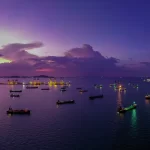
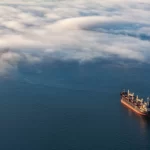
With Piraeus under China’s shipping giant and Thessaloniki linked to Russian-Greek business interests, Washington is now seeking a foothold in Greece’s strategic ports – but analysts say it may be too late to push Beijing out.
Athens’ legendary port of Piraeus, labelled the “dragon’s head” of the Mediterranean by President Xi Jinping, became a flagship Belt and Road asset, Beijing’s main vehicle for expanding its political and economic influence abroad, after Greece privatized it during the 2008 bailout.
“We found ourselves at a time when we desperately needed foreign investment and no one else was investing,” a former conservative minister under Prime Minister Antonis Samaras (2012-2015), who requested anonymity, told Euractiv. The former minister added that the Americans and Europeans “who are complaining today did absolutely nothing at the time.”
China’s state-owned shipping giant COSCO first secured a container-terminal concession and, in 2016, bought 67% of the Piraeus port authority, making it the majority operator.
However, with Donald Trump’s re-election, Washington has refocused on the Eastern Mediterranean following years of relative absence under Democratic administrations, and now appears determined to counter China in the region.
The new US Ambassador to Greece, Kimberly Guilfoyle – formerly engaged to Donald Trump Jr – last week openly questioned China’s presence, hinting Piraeus “could be for sale”.
The Chinese embassy condemned her comments as a malicious attack on normal Sino-Greek commercial ties, and a serious meddling in Greece’s internal affairs.
The Americans are also exploring alternatives to the Chinese-controlled Piraeus itself, like upgrading the Elefsina shipyards – a coastal town 18 km northwest of Athens – into a multi-use port.
Can China be kicked out of Piraeus?
The former minister, whom Euractiv talked to, saw little chance of overturning the COSCO agreement and suggested that the best option for now is to limit Chinese influence on Piraeus.
“China will now pursue the Pacta sunt servanda logic, meaning agreements must be kept,” he said.
George Tzogopoulos, senior fellow at the Hellenic Foundation for European and Foreign Policy, said COSCO’s investment in Piraeus is still evolving. He welcomed US investment proposals in Elefsina but cautioned that they must consider “timeframes and space restrictions”.
“To build a port in the long term is completely different from completing a typical business transaction,” he said.
He added that foreign competition over Greek ports could theoretically benefit the country economically, but warned that Athens must avoid being caught in US-China antagonism.
“I doubt Greece would have any leverage under the new conditions shaping Sino-American relations, but it should try not to be on their agenda,” he said, suggesting that Athens adopt a policy that keeps others satisfied or at least not disappointed.
Konstantinos Tsimonis, a professor of Chinese politics at Panteion University of Athens, is sceptical that Trump can drive China fully out, but believes his main aim is to reduce its presence and influence in Greek affairs.
Tsimonis also cited a Greek constitutional provision allowing the state to nationalise critical infrastructure in emergencies. “When there is will, there is a way,” he said.
He added that the EU is increasingly paying attention to critical infrastructure, including ports. An EU Port Strategy is expected to be announced in 2026 by the European Commission, with security as a key element.
The suffocation scenario
Tsimonis also suggested that the US could deploy “multi-level pressure” to restrict COSCO’s autonomy.
He said it may not be a coincidence that the government is preparing a draft bill, which could place ports under a central Hellenic public port authority, potentially limiting operators’ control, including COSCO’s.
Tsimonis predicted Athens will face increasing pressure in the coming years. The Chinese embassy’s reaction demonstrated “irritation,” fuelling rumours of an imminent visit by Xi Jinping, he said.
He warned, though, that the Chinese might refuse any concession and threaten legal action, compensation claims, or even a port shutdown to escalate the situation.
“I think this will be among the first clear clashes of the new Cold War”, he warned, adding that Greece traditionally aligns with the US, the dominant power in the Eastern Mediterranean.
Political silence in Athens
Greek politicians have largely stayed silent on the US-China tug-of-war, with only the foreign ministry issuing a statement saying Greece remains fully aligned with the US as a strategic partner but will respect agreements made in the past.
According to the former minister, no political party is likely to confront Trump’s initiatives in the country. However, domestic tensions could rise ahead of the 2027 elections, particularly among influential shipping circles.
Some political signs already hint at what’s to come.
Former conservative Prime Minister Kostas Karamanlis – who signed the initial COSCO deal – was honoured on Thursday by the Greek-Chinese chamber of commerce for strengthening bilateral ties.
At the ceremony, Karamanlis defended the 2008 Cosco agreement, saying that it was one of the biggest investments in the country. “Today, the port of Piraeus is the 8th largest in the world and 3rd in Europe,” he said.
Meanwhile, another former socialist Prime Minister Giorgos Papandreou, once a staunch opponent of COSCO’s investment, participated in this year’s Chinese military parade and attended a dinner hosted by the Chinese president.
Greek Prime Minister Kyriakos Mitsotakis often faces criticism from Karamanlis, particularly regarding his handling of foreign policy.
At the same time, Papandreou has positioned himself as a supporter of a progressive coalition government, making it more difficult for Mitsotakis to secure a governing partner after the 2027 elections. With the political landscape becoming increasingly fragmented, it is widely expected that a coalition government will be necessary.
Source: Euractiv.com