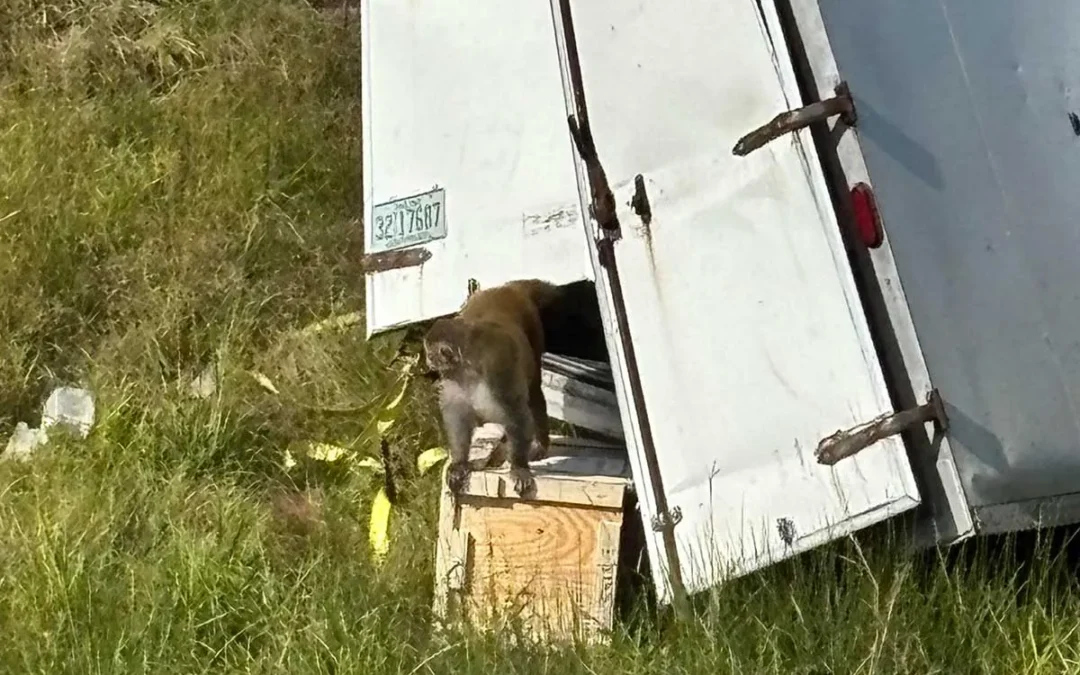
HEIDELBERG, MISSISSIPPI: Panic spread through parts of Jasper County on Tuesday after an “aggressive” rhesus monkey, reportedly carrying Covid-19, hepatitis C, and herpes, escaped following a truck crash involving laboratory primates.
According to the Jasper County Sheriff’s Department, the truck — transporting monkeys for research from a facility affiliated with Tulane University — veered off an interstate and landed in a ditch north of Heidelberg. The impact damaged several cages, allowing some primates to flee into a nearby wooded valley.
Authorities initially warned that the 40-pound rhesus monkeys were “aggressive to humans” and potentially infectious. “Do not approach these animals under any circumstances,” officials cautioned, advising residents to call 911 immediately if they spotted the fugitive monkey.
Most of the escaped primates were quickly captured and euthanised, but one remains missing as of Tuesday afternoon. The sheriff’s department has enlisted help from Mississippi Wildlife and Fisheries and a local animal disposal company in the ongoing search.
Tulane University Refutes Infection Claims
Tulane University swiftly dismissed reports that the monkeys were carriers of infectious diseases. In an official statement, the university clarified:
“Non-human primates at the Tulane National Biomedical Research Center are provided to other research organizations to advance scientific discovery. The primates in question belong to another entity and are not infectious. We are actively collaborating with local authorities and have dispatched animal care experts to assist.”
The university emphasized that all necessary safety protocols were being followed and called the initial warnings “inaccurate.”
Scientific Context
Rhesus monkeys — which typically weigh 9 to 26 pounds depending on sex — are among the most widely used non-human primates in biomedical research because of their close genetic similarity to humans. Their contributions to science range from vaccine development to understanding human blood groups.
Notably, the rhesus monkey Albert II became the first primate launched into space by the United States in 1948, paving the way for later human spaceflight programs.
Despite their crucial role in research, Tuesday’s incident reignited ethical and safety debates surrounding the transport of laboratory animals, particularly those used in infectious disease studies.
As of late Tuesday, the escaped monkey remained at large, and officials urged residents to remain alert — but not alarmed — while the search continues.