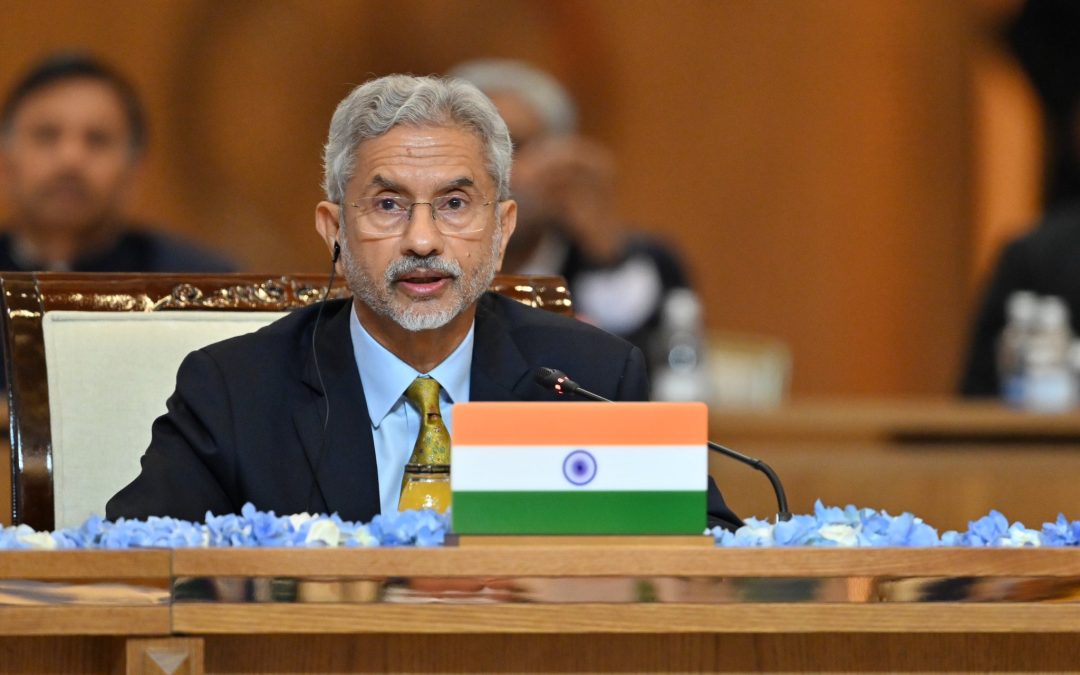
External Affairs Minister S. Jaishankar, speaking at the Shanghai Cooperation Organisation (SCO) Foreign Ministers’ meeting in Tianjin, China, condemned the recent terrorist attack in Pahalgam, calling it a deliberate attempt to damage Jammu & Kashmir’s tourism economy and foster religious tensions. His remarks came in the presence of Pakistan’s Foreign Minister Ishaq Dar, though Jaishankar refrained from directly naming Pakistan, in adherence to SCO protocol which discourages raising bilateral disputes.
Referencing the April 22 Pahalgam attack, Jaishankar underscored the need for the SCO to maintain a firm and uncompromising stance against terrorism. “India will pursue justice and hold the perpetrators accountable,” he declared, pointing out that the United Nations Security Council (UNSC), where both China and Pakistan are members, had strongly condemned the attack and called for justice.
“In India, we recently saw a stark example of the SCO’s core concerns—terrorism, separatism, and extremism—unfold together during the terrorist attack in Pahalgam. The intent was clear: to hurt the tourism-dependent economy of Jammu & Kashmir and inflame communal divisions,” Jaishankar stated.
While expressing India’s openness to cooperation and new proposals within the SCO, Jaishankar emphasized that such collaboration must respect sovereignty, territorial integrity, and mutual equality.
The foreign ministers’ meeting served to prepare for the upcoming SCO Summit in September, which will be hosted by Chinese President Xi Jinping. Prime Minister Narendra Modi is expected to attend, and India is pushing for strong language condemning terrorism—including the Pahalgam incident—in the summit’s final declaration.
Quoting the UNSC statement, Jaishankar reiterated: “The Council condemned the attack in the strongest terms and stressed the need to hold the perpetrators, organisers, financiers, and sponsors accountable. India has taken action and will continue to do so.” He called on the SCO to uphold its founding principles by adopting an unequivocal position on terrorism.
In a separate bilateral meeting with Chinese Foreign Minister Wang Yi, Jaishankar highlighted terrorism as a shared threat and urged SCO members to adopt a policy of zero tolerance. He also reaffirmed India’s commitment to a peaceful and stable Afghanistan, calling on the SCO to increase development aid for the Afghan people—an area where India will continue to contribute.
Jaishankar also criticized the lack of assured regional transit within the SCO, implying that Pakistan’s continued refusal to allow Indian land access to Afghanistan and Central Asia hampers regional economic cooperation.
He concluded by urging the SCO to rise above the global climate of conflict and competition. “As the world shifts toward multi-polarity, groupings like SCO must demonstrate unity and purpose. Our ability to influence global affairs depends on how effectively we align on shared priorities,” Jaishankar said.