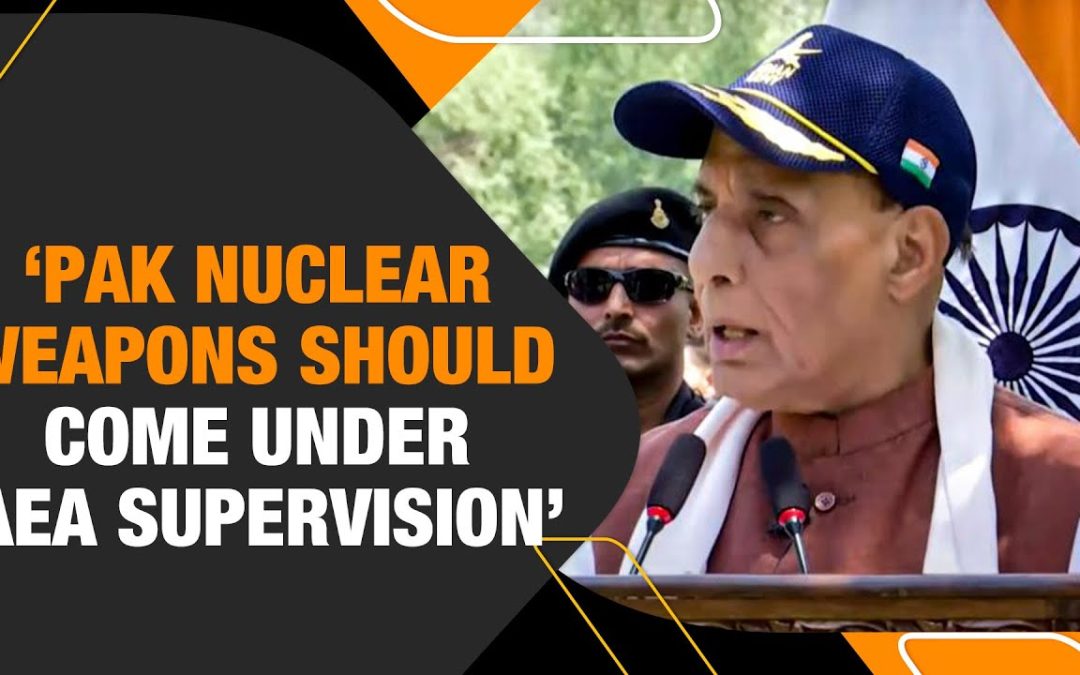
NEW DELHI — Defence Minister Rajnath Singh on Thursday labeled Pakistan a “rogue nation with nuclear weapons” and called for its nuclear arsenal to be placed under the supervision of the International Atomic Energy Agency (IAEA). Speaking to troops at Badami Bagh Cantonment in Srinagar during his first visit to Jammu and Kashmir since the launch of Operation Sindoor on May 7, Singh said Islamabad’s nuclear threats had failed to deter India’s firm response to terrorism.
“Prime Minister Modi has redefined India’s approach to terrorism — any attack on Indian soil is now treated as an act of war,” Singh declared. His remarks come on the heels of the PM’s strong message that Pakistan’s nuclear blackmail would no longer restrain India’s cross-border responses to terror attacks.
“Pakistan Has Long Deceived India”
India maintains a clearly articulated no first-use nuclear policy, while Pakistan deliberately keeps its doctrine ambiguous, frequently engaging in nuclear brinkmanship. Islamabad has showcased its short-range Nasr (Hatf-IX) and other missiles as countermeasures to India’s conventional superiority. Singh accused Pakistan of irresponsibly issuing nuclear threats, citing its history of reckless behavior and its proliferation ties with China and North Korea.
“Can the world consider nuclear weapons safe in the hands of such an irresponsible and rogue nation?” Singh asked. “I urge the global community to place Pakistan’s nuclear arsenal under IAEA supervision.”
He also highlighted Pakistan’s recent announcement — and subsequent withdrawal — of a meeting of its Nuclear National Command Authority, which raised international concern over its intent and credibility.
Operation Sindoor: India’s Strongest Message Yet
Calling Operation Sindoor India’s largest counter-terrorism strike to date, Singh praised the precision and resolve of the armed forces. “Our forces have shown the world what targeted and pinpointed action looks like. The body count is left to the enemy,” he said.
Referring to the Pahalgam massacre in which terrorists allegedly targeted tourists based on their religion, Singh said Indian forces had responded to terrorists “based on their karma, not dharma,” through deep strikes in Pakistan and Pakistan-occupied Kashmir on May 7.
“It was the dream of every soldier to strike at the heart of terrorist hideouts. It was our dharma to eliminate them,” he added, addressing troops alongside J&K Chief Minister Omar Abdullah and Army Chief Gen Upendra Dwivedi.
“Pakistan Will Pay a Heavy Price”
Singh reiterated India’s commitment to peace but warned of serious consequences if Pakistan continues to support terrorism. “We’ve never desired war, but if our sovereignty is challenged, a strong response becomes our duty,” he said. “If Pakistan persists in backing terror, it will have to pay an even heavier price.”
He also recalled Pakistan’s promise to former PM Atal Bihari Vajpayee over two decades ago to halt terrorism from its soil — a promise he said had been repeatedly broken. “Pakistan has long deceived India. It must stop harboring anti-India terror groups and prevent its territory from being used for attacks,” he asserted.
Contrasting the economic trajectories of the two nations, Singh pointed out Pakistan’s financial distress and dependence on IMF loans, while India contributes funds to support the IMF’s aid to poorer nations.